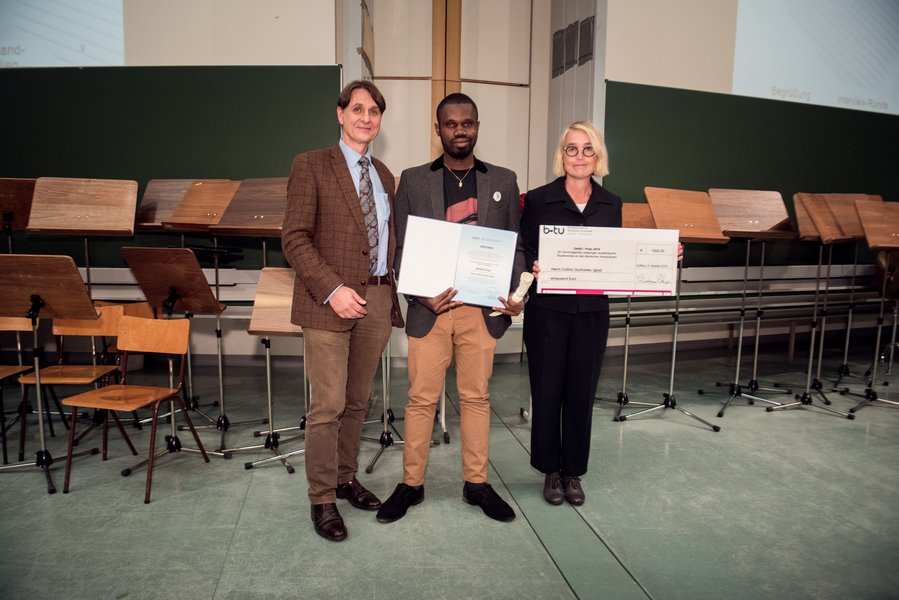
»There are many young Africans doing great things«
Der DAAD-Preis geht in diesem Jahr an Collins Izuchukwu Igboji aus Nigeria. Neben den hervorragenden akademischen Leistungen zeichnet er sich durch sein großes interkulturelles Engagement für die BTU Cottbus-Senftenberg aus. Ob bei Cottbus Open oder der African Cultural Night – er gestaltet aktiv das Unileben mit. Zudem ist er der Präsident der nigerianischen Studierendengruppe an der BTU.
BTU NEWS: What does the DAAD prize mean to you?
COLLINGS IGBOJI: I am honoured to be this years’ winner of the prestigious DAAD award. As a Pan-africanist, I appreciate this award greatly because of the opportunity it gave me to tell the other side of the African story. Whenever I walk down the street and see an African child depicted as a symbol of hunger and poverty on billboards, I feel bad and motivated as well. These billboards always challenge me to work hard and also learn from my environment so that I can contribute to the building of the Africa of tomorrow - The Africa we want. I believe this award has offered me the privilege to project Africa in another light other than a continent of hunger and poverty flying all over the media. I want the world to also know that there are many young Africans doing great things both within and outside Africa.
BTU NEWS: Could you tell us something about your student commitment and your university projects?
COLLINGS IGBOJI: As a student I have been actively involved in both social and academic activities within and outside the university. I have served as the public relations officer of the Nigerian students association in BTU and I am the currently the president of this association. Through this association I have contributed my quota by organizing social and sport activities with the support of good team members at different times. Last year, we participated in Cottbus open, organized a seminar for Nigerian students and wrapped it up with the maiden edition of the Nigerian cultural night. I took this to the next level this year by assembling a team of enthusiastic African students to organize and execute the first ever African cultural festival in BTU with ten African countries in participation and many students in attendance. Under my watch this year again, Nigeria had a good outing at this year’s Cottbus open and also played a friendly football game against the Latin American students. Academically, I am currently working on a contract as a scientific assistant in the chair of Environmental Sociology for a German-Nigerian project on Agricultural mechanization.
BTU NEWS: What do you like most about your studies and the BTU Cottbus-Senftenberg?
COLLINGS IGBOJI: The interdisciplinary nature of ERM programme attracted me first to the degree. As a Master degree student here, I have been impressed with the high quality of the modules taught in this programme which covers all the pressing environmental challenges of the 21st century and most importantly, how to tackle them. For someone like me that have a background in Botany in my Bachelors, the flexibility of the programme gave me the opportunity to select the modules that I know will be helpful to achieve my interest which is the phytoremediation of oil polluted soils- a major environmental problem in my home country, Nigeria. I must also quickly add that the friendly attitudes of the lecturers and the students mean a lot to me. Coming to BTU has been one of the best decisions I have ever made. The international status of the university has given me the opportunity to meet students from other countries and learn more about their countries and culture. I feel at home here because of the great number of Nigerians and other Africans here. Also both the teaching and non teaching staff are very open and approachable. I must quickly commend the services of the staff at the international relations office whose services are top-notch and very professional. In fact I have never left IRO since i came to Cottbus with my problem unsolved.
BTU NEWS: Talking about the future: what comes next?
COLLINGS IGBOJI: After my Master degree, I intend to get enrolled in a PhD programme which preferably will be on a project centered on the phytoremediation of oil polluted sites and/or bioenergy. As a flexible person and someone passionate about African development, I will not mind working with any international developmental agency or project anywhere in Africa to gain some experience.
Thank you for the interview!