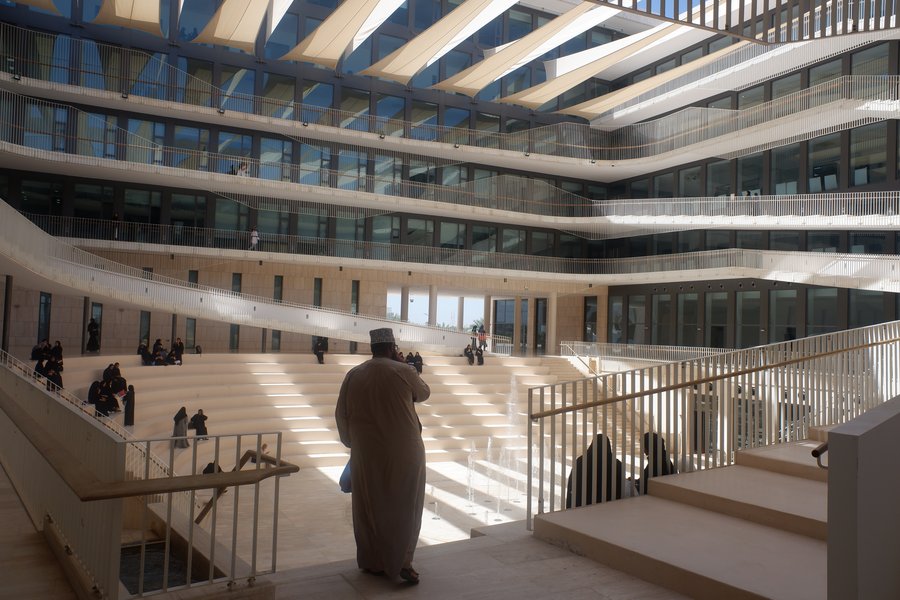
How Doha, Dubai & Ras al-Khaimah are becoming global education hubs
How are cities in the Arabian Gulf region becoming "knowledge economies" with the help of international university campuses abroad: the governments of Doha, Dubai and Ras al-Khaimah are specifically using so-called Transnational Education Zones (TEZ) to attract Western universities. These zones advertise ideal infrastructure, low administrative hurdles and an international academic environment. Universities should benefit from favourable building plots, student flows from all over the world and a global lifestyle, while the cities want to attract highly qualified specialists, innovation and international visibility.
"Cities should become global education hubs by specifically redirecting global flows of knowledge, capital and talent," says Dr Rottleb. However, the results of this strategy vary greatly. "In fact, foreign degrees obtained at campuses abroad often reinforce existing inequalities between population groups in the Gulf region," says Rottleb. "The zones also succeed in attracting international universities through market-based incentives, but these are usually limited to lucrative, easily exportable study programmes and there is hardly any local research." His research shows that these TEZs are not just physical spaces, but strategically orchestrated exceptional spaces in which economic diversification, the pressure for global competitiveness and the expectations of a knowledge economy converge.
International recognition
The paper "Building the Knowledge Economy, Transforming Cities? Transnational Education Zones as a Multi-Scalar Development Strategy in the Arab Gulf Region" by Dr Tim Rottleb was written at the Leibniz Institute for Spatial Social Research, defended at Humboldt-Universität zu Berlin and awarded Summa cum Laude.
The dissertation was published in 2024 in the book series Politics and Society of the Middle East by Springer VS and received the prize of the German Middle East Studies Association (DAVO) for the best dissertation in German or English in the field of contemporary research on the Near and Middle East. In 2025, she was also honoured with the Peter Meusburger Doctoral Prize for outstanding dissertations in the field of "Geography and Knowledge".
About the author
Since January 2025, economic geographer Dr Rottleb has been a postdoctoral researcher at the Brandenburg University of Technology Cottbus-Senftenberg in the field of economics macroeconomics. Since February 2026, he has headed the project research group "Vitalisation of Regional Innovation Systems in Peripheral Areas" at the Centre for Structural Change and Regional Development (ZeStuR) and coordinates the DFG network "Geographies of Economic Ideation and Spatial Transformation".
His key research areas include the interplay between regional development and globalisation, the knowledge economy and economic transformation processes.
Contact us
Press contact