Old craft told in a new way: Blueprint weekend puts memories in the spotlight
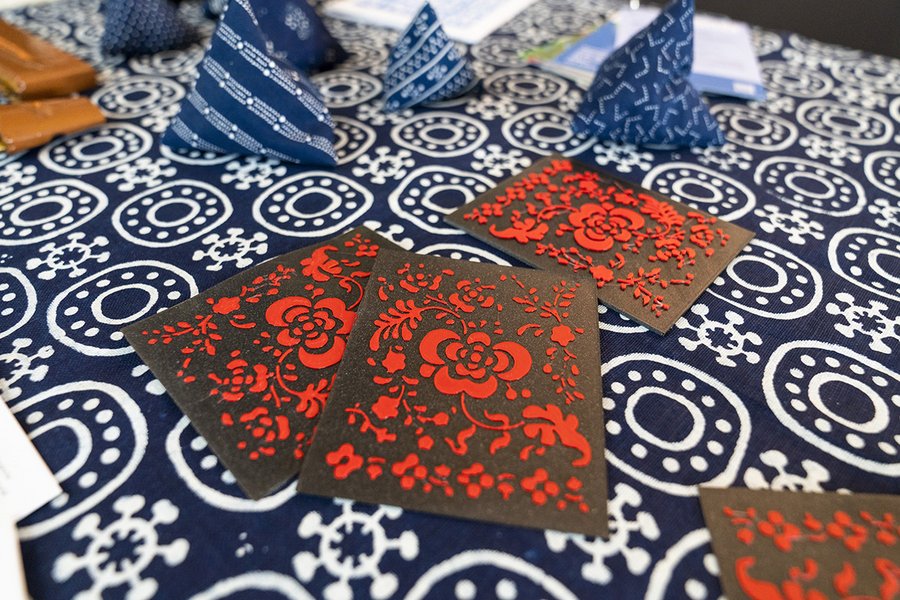
Blue printing is one of the most traditional textile techniques in Europe: patterns are applied to fabrics with models, which are then dyed with indigo - leaving the characteristic white ornaments on a deep blue background. In Lusatia, this technique is closely associated with regional costumes and cultural identity. But it is precisely this knowledge that is under threat. With the decline of craftsmanship, the knowledge gained from experience - often carried by older generations - is also disappearing.
How can a craft that was mainly passed on orally be preserved? The blueprinting weekend on Friday and Saturday, 27 and 28 March, at the Wendish-German Museum of Local History in Jänschwalde/Janšojce is dedicated to this question - with a special focus on the storytelling café.
"If this knowledge disappears, we lose more than just a technology - we lose a piece of cultural identity and personal life stories," says Richard Pantzier from the Brandenburg University of Technology Cottbus-Senftenberg (BTU).The scientist accompanies the BTU project Praxisforschungsstelle Cottbus. The aim is to make precisely this often invisible body of knowledge visible and pass it down through the generations. The Praxisforschungsstelle sees the weekend as a field of experimentation for new forms of intergenerational learning.
The storytelling café invites you to share personal stories about blueprinting - or simply to listen. In an informal atmosphere with coffee and cake, a living archive of everyday knowledge is created. The Storytelling Café is moderated by Jörg Ackermann, part of the steering committee of the valorisation project. In addition to the storytelling café, the programme also includes workshops and insights into an experimental workshop being created.
About the programme
Friday, 27 March 2026
- 3 p.m. Storytelling café
- 4.30 pm, insight into the experimental workshop in progress.
Saturday, 28 March 2026,
- 10 a.m. Easter egg painting workshop in the museum.
- 1 p.m. "Colouring with indigo" workshop with Petra Jordan (already fully booked)
Venue: Wendish-German local history museum Jänschwalde - Serbsko-nimski domowniski muzej Janšojce, Kirchstraße 11, 03197 Jänschwalde/Janšojce
All interested parties are warmly invited. Please register with the local history museum: T +49 (0) 35607 749928, E museum-jaenschwalde(at)peitz.de
The events are organised by the BTU project Praxisforschungsstelle Cottbus, the project Inwertsetzung immateriellen Erbe im deutsch-slawischen Kontext and the Heimatmuseum Jänschwalde/Janšojce.
About the project Valorisation of intangible heritage in the German-Slavic context
The project supports the implementation of the storytelling café and the colouring workshop. The long-term plan is to set up a blue printing workshop in Jänschwalde/Janšojce as a demonstration and experimentation workshop at the Wendish-German Heritage Museum in order to preserve the dyeing technique and, for example, to maintain it for use in Sorbian/Wendish traditional costumes.
About the Cottbus Practical Research Centre
The Practical Research Centre Cottbus is a project of the BTU Cottbus-Senftenberg. Researchers at the centre focus on improving the quality of life in old age and thus contribute to making the regional and individual knowledge of the older generation in the district of Spree-Neisse and Cottbus/Chóśebuz more visible. The Practice-Research Centre Cottbus is part of the AlterPerimentale transfer initiative. This works in the German-Polish border region to improve the quality of life in old age. Together with older people and practitioners, the researchers are developing new solutions for living together in the face of demographic change. The various sub-projects are working in the districts of Oder-Spree, Spree-Neisse and Görlitz as well as in Cottbus/Chóśebuz on different topics such as healthcare, mobility, inclusive digitalisation and loneliness. The AlterPerimentale is funded by the Federal Ministry of Research, Technology and Space (BMFTR) as part of the "T!Raum - TransferRäume für die Zukunft von Regionen" funding programme.
Specialist contact
Press contact