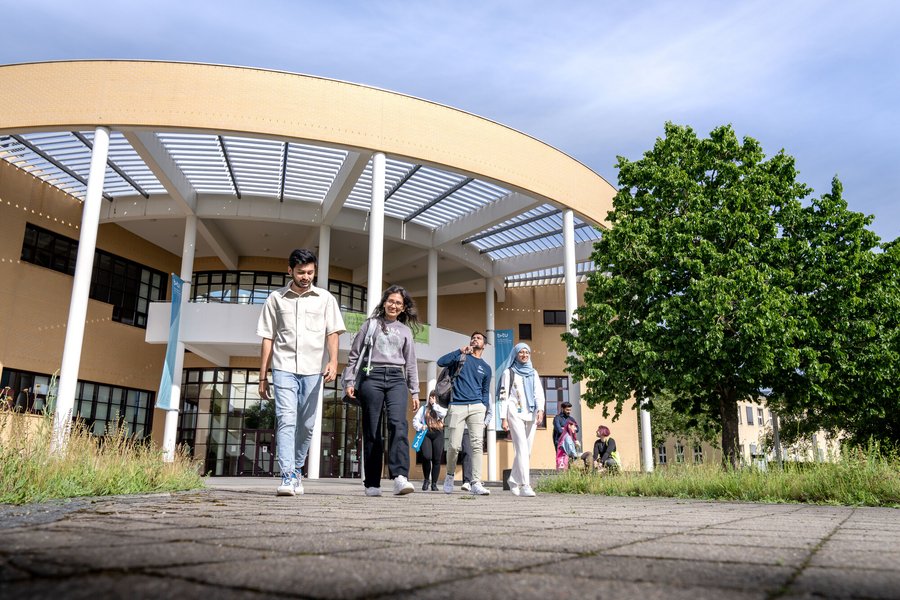
For the first time, Brandenburg is offering a degree course to train teachers of Sorbian/Wendish
Brandenburg is investing in the future of the Sorbian people. From autumn 2026, the Brandenburg University of Technology Cottbus-Senftenberg (BTU) will launch Sorbian/Wendish as a second subject within the primary school teacher training degree programmes at its Campus Senftenberg/Zły Komorow. This will mark the first time that primary school teachers in the state of Brandenburg will receive foundational training in Sorbian/Wendish. The Council for Sorbian/Wendish Affairs (RASW) presented the course offering today at the Brandenburg State Parliament in Potsdam, together with the Ministry of Science, Research and Culture of the State of Brandenburg, BTU Cottbus-Senftenberg and the Sorbian Institute.
Marcus Koinzer, board chairperson of the RASW: “Since the last legislative period, the RASW has been actively campaigning for the realisation of this programme in Lower Lusatia. Special thanks go to the MWFK for initiating the project and to the BTU for the ambitious yet professional establishment of the study programmes in collaboration with the Sorbian Institute, in order to meet the continuing high demand for Sorbian/Wendish teachers.”
Delia E. Münch, RASW spokesperson for education policy: “Lower Sorbian/Wendish is a language threatened with extinction that urgently needs to be taught in schools. However, the BTU’s Sorbian/Wendish teacher training programme is not only of practical relevance, but also reflects the BTU’s self-image as a university in a bilingual and bicultural Lower Lusatia. This benefits students, lecturers and the region in equal measure.”
Tobias Dünow, Brandenburg’s Commissioner for Sorbian/Wendish Affairs and State Secretary in the Ministry of Science, Research and Culture of the State of Brandenburg: “The launch of the teacher training programme this year is likely to be one of the most significant policy decisions in Sorbian/Wendish affairs over the past 10 years. The close cooperation between the state, the BTU, the Sorbian Institute and the RASW, and the strong support from local authorities send a clear signal: together, we are securing the future of the Sorbian/Wendish language and culture, and thus of the Sorbian people. We are also breaking new ground to bring this long-standing constitutional mandate to life day by day. The new programme is a perfect fit for the BTU. Not only because Senftenberg/Zły Komorów lies within the Sorbian settlement area, but also because the university has demonstrated that it can very quickly establish a teacher training programme that is exceptionally practice-oriented and tailored to the specific needs of the region.”
Prof. Dr Peer Schmidt, Vice-President of the Brandenburg University of Technology Cottbus-Senftenberg (BTU): “The new study programmes at the BTU are the result of an impressive commitment from many stakeholders in the region – naturally from the Sorbian/Wendish community, above all the Council for Sorbian/Wendish Affairs in the State of Brandenburg and the Sorbian Institute, but also the towns and districts as well as the schools in Lower Lusatia, where teachers are urgently needed. Last but not least, the excellent cooperation with those involved at the BTU was crucial to the successful development of the study programme. As a result, our students will experience a very special environment in which, right in the heart of the Lower Lusatian settlement area, they can directly experience and develop the language, history and culture of the Sorbs/Wends and engage with their institutions.”
Prof. Dr Hauke Bartels, Director of the Sorbian Institute: “A sufficient number of well-trained Lower Sorbian teachers in primary schools is a necessary condition for the preservation of the Lower Sorbian language in Brandenburg. The new study programme offers the opportunity to activate and make even better use of the potential for recruiting such teachers. As the only research institution dedicated to the language, history and culture of the Sorbs/Wends, the Sorbian Institute will continue to actively support the new programme in its design and implementation.”
The BTU is expanding its teacher training programme at the Campus Senftenberg/Zły Komorów for the 2026/27 winter semester to include Lower Sorbian/Wendish as a second subject for primary education. This marks the first time that an undergraduate degree programme for training Lower Sorbian teachers in primary schools has been established in the Sorbian/Wendish settlement area of Brandenburg. The programme is designed as a practice-integrated Bachelor’s degree and is intended to be followed by a dual Master’s programme. Students can choose between the subject combinations Mathematics – Sorbian/Wendish or German – Sorbian/Wendish. Twelve places are planned annually, six for each subject combination. Practical teaching experience is to be provided, amongst other things, through WITAJ schools and schools offering Sorbian/Wendish as a foreign language.
The programme is initially aimed at applicants who already have language skills – knowledge of Lower Sorbian at B1 level is recommended. From next year, supplementary bridging courses and preparatory modules are intended to facilitate access for new learners as well. Applications will be accepted from 27 April 2026. Scholarship programmes run by the state, the Foundation for the Sorbian People and several local authorities, including Cottbus/Chóśebuz and the district of Spree-Neiße/Wokrejs Sprjewja-Nysa, are intended to boost the study programme’s appeal.
The programme has been developed in close consultation between the Ministry of Culture and Science, the Brandenburg University of Technology Cottbus-Senftenberg, the Council for Sorbian/Wendish Affairs, the Sorbian Institute and the Ministry of Education. The BTU plans to build up additional staff capacity to deliver the new programme. Cooperation with the University of Leipzig will continue. The University of Leipzig will continue to offer Sorbian studies and teacher training for secondary schools.
The Sorbs/Wends have been settled in Lusatia for around 1,500 years. Despite attempts at assimilation by earlier rulers and governments, they have preserved their own language and their culture, which is characterised by numerous festivals and a rich variety of customs. The Lower Sorbian language belongs to the Slavic language family, is a recognised minority language in Germany and is protected in Brandenburg by the state constitution. The state of Brandenburg is contributing to the better preservation and further development of the culture and language of this national minority through a range of measures. This year, the state is supporting the Foundation for the Sorbian People with around 4.9 million euros.
Contact
Press contact