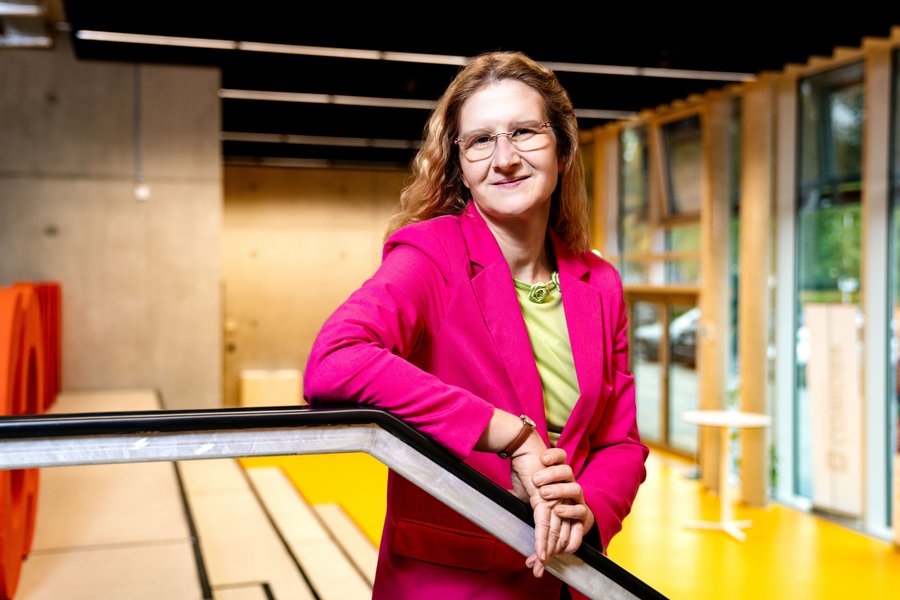
"Understanding the big picture – and then seeing the tiny details"
Even as a child, she would sit on the balcony, gaze up at the starry sky and ask herself questions that were bigger than anything she could grasp: Where does the light of the stars come from? How old is the universe? And what actually holds everything together?
“This unimaginable nature of space and time – it has never let me go”, says BTU scientist Prof. Dr Christine Ruffert. “I also like to quote Goethe here: ‘What holds the world together at its very core.’”
From wonder to science
Her journey into Physics did not begin with formulas, but with curiosity. A defining moment: a book by her father about Einstein’s famous formula. “I was perhaps twelve and didn’t understand a thing. But that’s exactly what appealed to me. I wanted to know what was in there and get to the bottom of it to understand.”
This mixture of fascination and frustration became her driving force. For the scientist, Physics meant not just knowledge, but the ability to explore the world for herself. “You learn to deduce things – and to think your way into completely new subjects.”
A memory from her student days shows that with a background in Physics, you learn to comprehend the world: “A professor said: ‘This semester we’ll understand why I can’t reach through the table with my hand – even though atoms are mostly empty.’ – I was eager to hear the explanation!”
Between the cosmos and the microcosm
What began as an interest in the universe led Christine Ruffert in the opposite direction: into the world of the very small. Microsystems engineering became her chair – a decision made on a whim. “I saw it in the minor subjects catalogue and knew immediately: that’s it!”
As a doctoral candidate in the cleanroom, she crafted microscopic structures herself – precise, delicate, almost artistic. “I’m also an aesthete. These fine structures, shimmering in every colour – there’s something incredibly fascinating about them.”
And it’s about more than just technology: “I need to create something. I want to hold something in my hand at the end and say: I made that.”
Research with an impact
Today, the scientist at the Micro and Nano Systems chair combines basic research with application – bridging the gap between the university and the Fraunhofer Society. It is precisely this interface that matters to her. “I never wanted to just do research in an ivory tower (which in our case is probably made of the wafer material silicon). I want what we do to benefit society.”
A central theme: sensor technology as the foundation of digitalisation. “Sensors are the sensory organs of digitalisation,” as BTU Professor Harald Schenk once put it – thereby describing a key role of the discipline. For without measurement data, there is no digitalisation:
whether in smart homes, medical diagnostics or industrial plants – sensors provide the basis for Intelligent Systems everywhere.
When machines learn to “feel”
The researcher is particularly fascinated by the industrial application: predictive maintenance. “We teach machines to ‘notice’ when they are about to break down.”
The aim is to improve maintenance cycles. Put simply, predictive maintenance aims to ensure that machines and systems are maintained proactively when necessary, so that unplanned downtime or quality losses are avoided as far as possible. Unplanned downtime leads to disruptions, chaos, high costs and orders being delivered late.
Sensors detect the slightest changes, whilst algorithms recognise patterns. The aim: to prevent breakdowns before they occur. “When a large machine comes to a standstill, it immediately costs enormous sums of money. If we can prevent that, it represents huge added value.”
The lab comes to the patient
But Christine Ruffert is not only interested in industry. She sees a major field of the future in medicine and care. “We must enable people to live at home for longer – even in old age or when ill.” Sensor technology can record vital signs, facilitate diagnoses and make care more efficient. – Point-of-care diagnostics: “The laboratory comes to the patient.”
Transfer rather than an ivory tower
She is particularly keen on fostering exchange between academia and industry. Through the transfer conference she initiated, iCampµs Cottbus Conference 2026, Christine Ruffert brings both worlds together.
“For many companies, the university is a black box. And many researchers don’t know what’s needed out there.”
Her goal: genuine collaboration. “One side shows what they can do – the other says what they need.”
Women in science: performance and attitude
As a woman in a male-dominated field, the scientist has had varied experiences. “Women often have to work harder to be noticed – that’s just the way it is.” Role models and networks are crucial. “You need people who support you and should pass that on later.”
Explaining science – taking responsibility
Alongside research, Christine Ruffert sees a clear social responsibility: education. “We must explain what we do – in a way that is understandable and tangible.” This is particularly crucial in times of misinformation. “Ignorance breeds fear. And the only thing that helps against that is understanding.”
Standing still is not an option for the scientist. “If we were satisfied with what we’ve achieved, we wouldn’t keep developing. We’d still be sitting in the trees.” She smiles.
Her personal passion remains environmental and climate protection. And so the arc of her journey continues – from gazing at the stars to developing intelligent sensors. Or, as she puts it herself: “Understanding the big picture – and then becoming very small.”
Contact