Industrial decarbonisation as a bridge between Lusatia and Australia
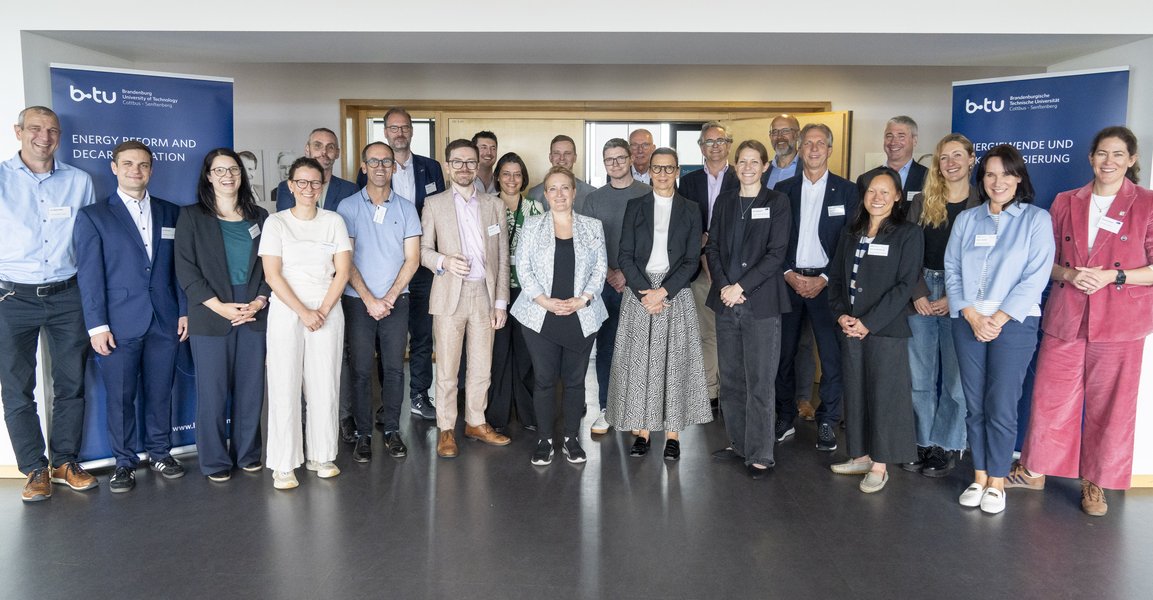
Leading representatives from industry, academia, the financial sector and politics in Australia are visiting the Brandenburg University of Technology Cottbus-Senftenberg (BTU) in Cottbus to learn about innovative solutions for decarbonising energy-intensive industries. The focus is on research into electrification, high-temperature heat pumps, energy efficiency, the hydrogen economy, and the development of climate-neutral value chains for products such as green iron, ammonia and methanol.
The visit is taking place as part of the German-Australian Energy and Climate Partnership, with the support of the Federal Ministry for Economic Affairs and Energy (BMWE), and underscores the growing international significance of Lusatia as a model region for the climate-neutral transformation of industry and energy systems. BTU President Prof. Dr Gesine Grande will open the event together with partners from the Cluster for Industrial Decarbonisation (CDI), a consortium comprising BTU, the Fraunhofer Institute for Energy Infrastructure and Geothermal Energy (IEG), the Institute for Low-Carbon Industrial Processes at the German Aerospace Centre (DLR), and the Competence Centre for Climate Protection in Energy-Intensive Industries (KEI).
Lusatia as a real-world laboratory for industrial transformation
As part of an expert dialogue, researchers and institutions from Lusatia will present current developments in the fields of industrial transformation, energy infrastructure, climate protection policy and Power-to-X technologies.
BTU researcher Prof. Dr Roh Pin Lee will present a multidimensional STEEP approach to industrial transformation in Germany. Further contributions will address integrated energy systems, high-temperature heat pumps for industries that are difficult to decarbonise, and the policy framework for the climate-neutral industry of the future.
New partnerships for climate-neutral value chains
The Australian guests are particularly interested in the prospects for German-Australian cooperation along new climate-neutral supply chains. Australia has excellent conditions for the production of green hydrogen, green iron and green ammonia and could play an important role in the future as a supplier of climate-neutral raw materials to Germany and Europe.
The delegation includes representatives from the Energy Efficiency Group, the Australian Hydrogen Council, the Australian National University (ANU), the University of New South Wales (UNSW), the Mission Possible Partnership, the Australian Industry Group, the Climateworks Centre and the mining and technology group Fortescue.
With a view to global climate policy
The visit takes place against the backdrop of increasing international climate protection efforts and with a view to the UN Climate Change Conference COP31, which will take place in Antalya, Turkey, at the end of the year. Australia is playing a central role in the international negotiations to accelerate the global energy transition and industrial transformation.
A practical example of climate-friendly industrial processes
The visit concludes with a tour of the DLR pilot plant “CoBra” in Cottbus. The demonstration platform for high-temperature heat pumps generates process heat of up to 300 degrees Celsius and is regarded as a pioneering technology for the decarbonisation of energy-intensive industrial processes.
With the visit of the Australian delegation, the BTU is strengthening its international network and positioning Lusatia as a major innovation hub for the climate-neutral industry of tomorrow.
Contact