In the footsteps of the polar pioneers
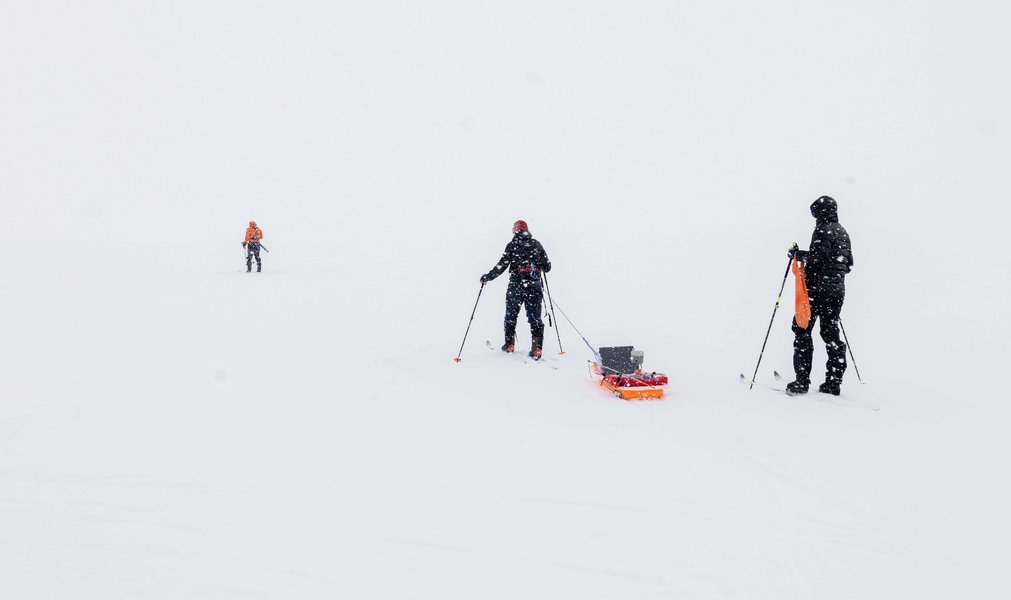
It is a scientific expedition reminiscent of the golden age of polar exploration: the team of six expedition members is currently making its way across the Greenland ice sheet in freezing temperatures, headwinds and snowfall. The team is travelling completely self-sufficiently – without engines, using only skis, kites and heavy sledges (pulkas).
Their aim is to repeat the historic route taken by polar explorer Alfred de Quervain in 1912 and, for the first time, to reconstruct it in the original direction from west to east during the same season. At the same time, they are providing up-to-date measurement data. The first 350 kilometres of a total of just under 700 kilometres and 2,450 metres of elevation gain have been completed. They now have roughly the same number of days ahead of them in the eternal ice.
Changes over 30 years and research into microplastics
The warmer the summers become, the more difficult the expeditions become. The team is making use of the time before gigantic melt lakes, meltwater streams and exposed crevasses render the route impassable. The research expedition is part of a long-term measurement project initiated by Prof. Wilfried Korth at the Berlin University of Applied Sciences in 2002, which is being continued by the BTU and other supporters. It builds on what has now become a comprehensive series of measurements on the development of the Greenland ice sheet.
The organisation and execution of the expedition are the sole responsibility of the participants. For example, an energy box (photovoltaic module, batteries) adapted to the conditions was designed and built as essential equipment for the research expedition. Without a stable energy supply under polar conditions, these measurements would not be possible. To verify the efficiency of the power supply, spectral analyses are being carried out to compare the efficiency of photovoltaic modules between an uninfluenced atmosphere and the site in Cottbus.
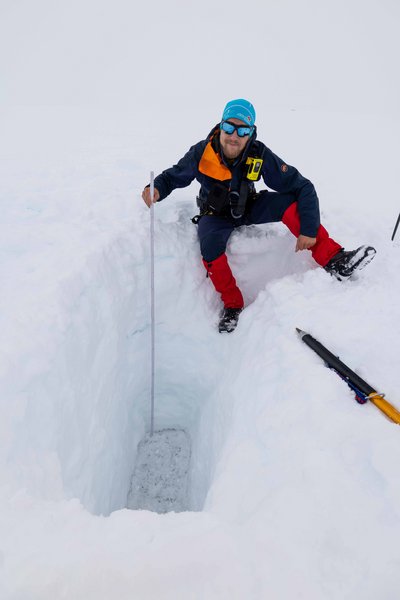
Despite adverse weather conditions, the scientific monitoring is in full swing: the researchers are recording ice thicknesses, snow densities and meteorological data, which are compared with data from previous expeditions using high-precision GNSS satellite measurements. In this way, they are documenting long-term changes to the ice sheet, such as thinning ice layers at the edge. The new Trimble R980 system is being used for the GNSS measurements; it is mounted on the pulka (sledge) and records a data set every second, amounting to approximately 1.6 million measurements over the entire route.
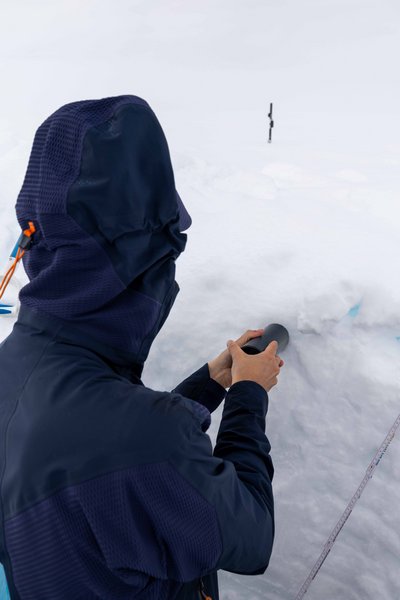
At the start of the expedition, the so-called ‘Stoberfeld’ was fully surveyed at 48 points. The field, named after Prof. Dr.-Ing. Manfred Stober (formerly of the Stuttgart University of Applied Sciences in the field of surveying), has been regularly studied for more than 30 years. On behalf of the University of Fribourg (Université de Fribourg), the team is taking snow and ice samples along the entire route to investigate microplastics in the ice.
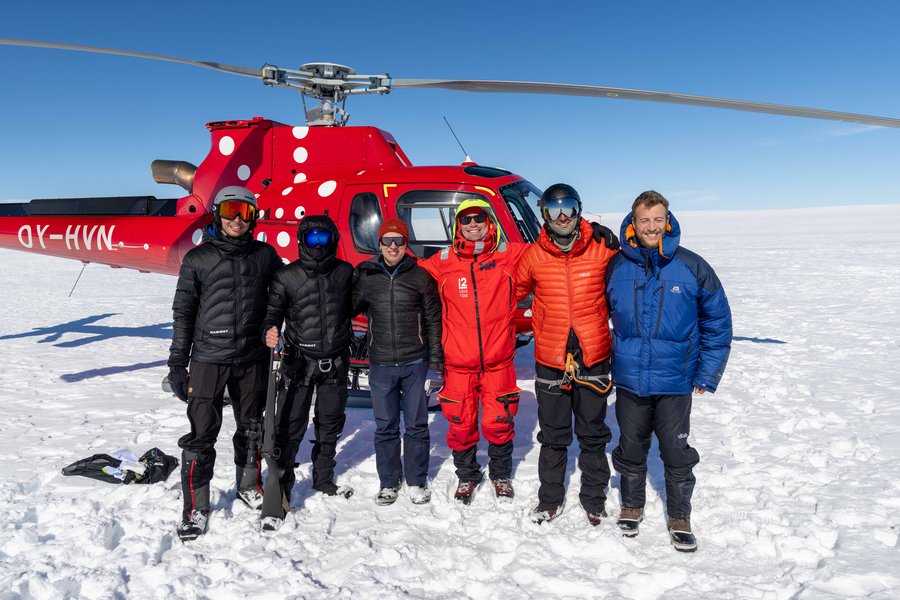
Representing the BTU, Thomas Hitziger (chair of Structural Mechanics and Numerical Methods) as expedition leader, Tom Scheppan as a researcher (chair of High-Voltage Engineering and Electrical Systems), and Paul Gasch, a Bachelor’s graduate in Civil Engineering, are participating in the research expedition.
The expedition in a live ticker
The adventure and the harsh daily life on the ice are being filmed by a team member – this footage will be used to create a documentary film following the expedition. Anyone wishing to follow the team up close and in real time on their journey through Greenland has the opportunity to do so daily:
Daily reports & insights:On Instagram at @iceploration (supported by the non-profit association of the same name dedicated to raising awareness of polar issues).
Live location via satellite tracking:share.garmin.com/btu
Contact (after the expedition)
Thomas Hitziger (Expedition Leader)
Chair of Structural Mechanics and Numerical Methods,
T +49 (0) 355 69 2269,
E thomas.hitziger(at)b-tu.de
Contact the team
Press contact