From the lecture to CERN
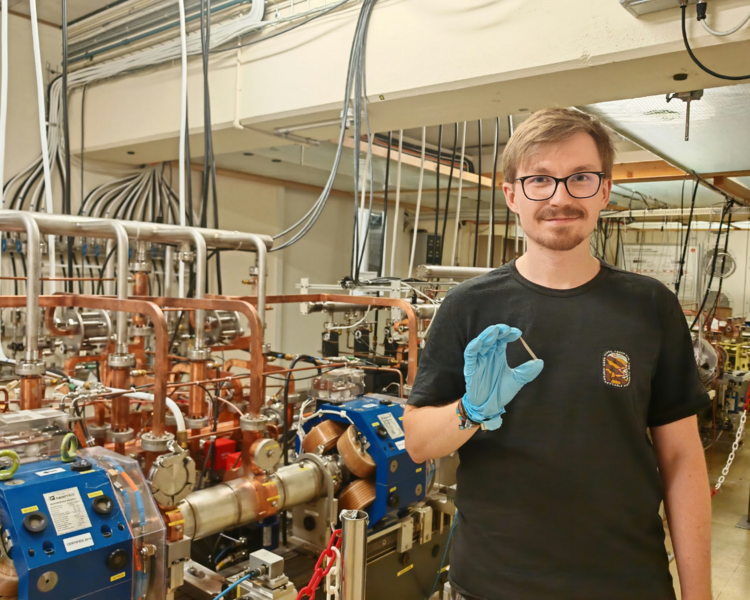
Geneva, CERN Research Centre: For several months now, a student from the Brandenburg University of Technology Cottbus-Senftenberg (BTU) has been working alongside Nobel Prize winners in Physics and leading international teams – right at the heart of one of the most ambitious projects in the history of science. Severin Schmidt is working on a tiny component that could play a decisive role in the success of research facilities costing billions. The absorbers, which are just five millimetres long and coated with a layer 40 nanometres thick, are designed to suppress electromagnetic interference that would otherwise destabilise the particle beam. A single next-generation accelerator would require over a million of these components.
“It fascinates me that a component measuring just a few centimetres in size can help determine whether a research facility several tens of kilometres long achieves its full potential,” says Severin Schmidt. “It is precisely this interface between fundamental physics and engineering that makes this Master’s thesis so exciting for me.”
“The fact that a BTU student is conducting research into such a key technology at CERN is a strong indication of the quality of our education,” emphasises Prof. Dr.-Ing. Thomas Flisgen, supervisor of the thesis at the BTU’s chair of Theoretical Electrical Engineering. “Our students not only learn the fundamental principles of physics, but also apply them to questions that are helping to shape the future of particle physics worldwide. This impressively demonstrates that cutting-edge research also begins in Cottbus.”
From the lecture to cutting-edge international research
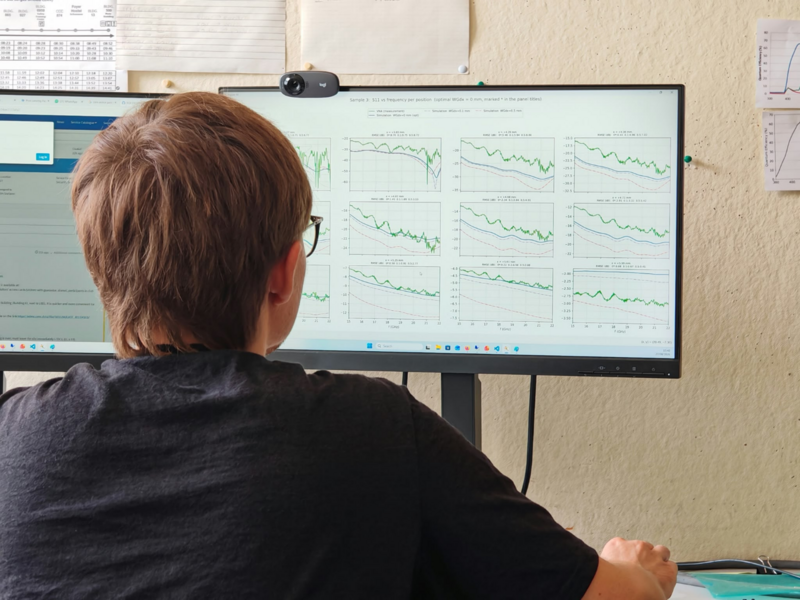
The Master’s thesis “Characterisation of surface-conductivity-based high-frequency absorbers” combines elements from high-frequency engineering, electrodynamics, Materials Science and numerical simulation. What begins in the lecture theatre with Maxwell’s equations, wave propagation or network analysers finds its application at one of the world’s most renowned research centres.
Severin Schmidt is investigating a completely new type of high-frequency absorber. Instead of solid ceramic components, his research group’s concept utilises a conductive layer just 40 nanometres thick, whose surface electrical resistance is precisely adjusted. This allows disruptive electromagnetic waves in the gigahertz range to be absorbed particularly efficiently.
A component for the accelerator of the future
Particle accelerators are the microscopes of modern Physics. It was with their help that the Higgs boson was discovered at the Large Hadron Collider (LHC) in 2012. Attention is now turning to the next generation of facilities. Whilst the Future Circular Collider (FCC), with a circumference of around 91 kilometres, is regarded as the preferred successor to the LHC, technologies for alternative concepts such as the Compact Linear Collider (CLIC) are being continuously developed.
This is precisely where the work of the BTU student comes in. His research helps to control the electromagnetic disturbances that arise from the extremely closely spaced particle bunches. Without effective absorbers, these disturbances would deflect the beam and, in the worst-case scenario, render the annex inoperable.
Cutting-edge research with implications far beyond particle physics
The findings of the Master’s thesis extend beyond a single collider concept. Surface-conductivity-based absorbers are considered promising, amongst other things, for future superconducting accelerators operating at temperatures close to absolute zero, particularly linear accelerators with energy recovery such as bERLinPro in Adlershof or PERLE in Paris. At the same time, such developments drive innovation in high-frequency technology, Materials Science, cryogenics and vacuum technology – technologies that will later find their way into medicine, industry and communications.
This Master’s thesis thus spans the spectrum from a lecture theatre at the BTU, through CERN, to the largest research facilities of the future. It impressively demonstrates how university education gives rise to world-class international research and how a small component can help to unravel some of the greatest mysteries of our universe.
Contact