BTU is involved in the development of more sustainable plastics
Polystyrene is one of the world’s most important plastics – made from crude oil, produced in an energy-intensive process and virtually non-recyclable. An international research team led by the Helmholtz Centre Hereon, in collaboration with the Brandenburg University of Technology Cottbus-Senftenberg (BTU), the Free University of Berlin and Helmut Schmidt University in Hamburg, has developed an alternative polystyrene that contains renewable raw materials, is produced more energy-efficiently and can be specifically degraded at the end of its life cycle.
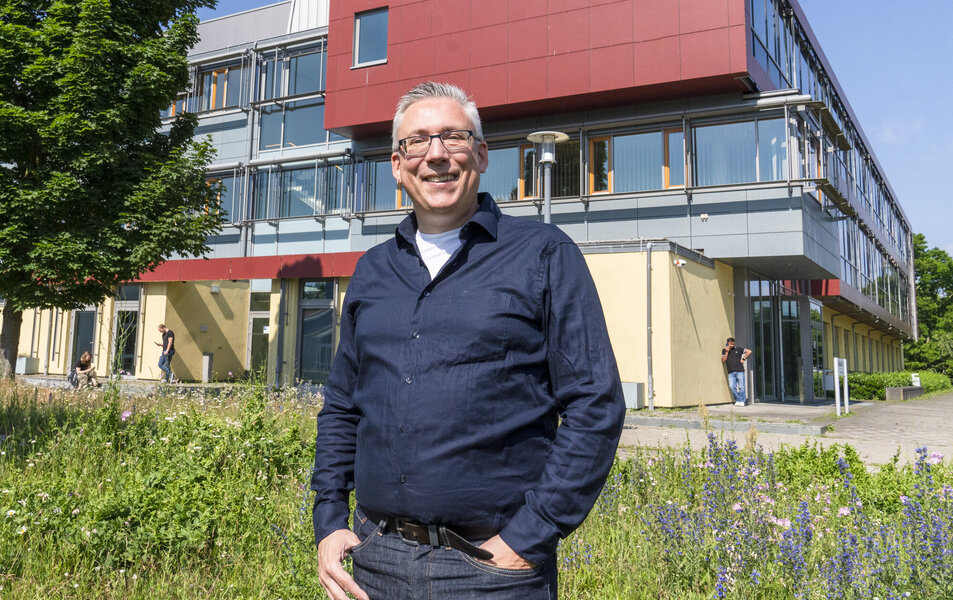
The Senftenberg research group led by Prof. Dr. rer. nat. Axel T. Neffe, at the Organic Chemistry chair specialising in polymers, is contributing its expertise in polymer chemistry and the targeted material design of hydrolytically degradable plastics suitable for biomedical applications to the project, thereby strengthening the Lusatia region as a centre of scientific excellence in a future-oriented field of the Circular Economy.
“We must design materials in such a way that their fate and potential recycling are taken into account right from the start,” says Prof. Dr. rer. nat. Axel T. Neffe, Professor of Organic Chemistry specialising in polymers at BTU Cottbus-Senftenberg. “This project exemplifies how interdisciplinary collaboration across different locations can help make one of the world’s most widely used plastics fit for the Circular Economy. For the BTU, this is another step towards visibly applying our expertise in sustainable materials chemistry in practice.”
A plastic with a future
Conventional polystyrene is produced by heating styrene molecules to form a durable plastic that can hardly be broken down into its constituent parts. The research team replaced part of the styrene with itaconic anhydride, a compound that can be obtained through fermentation from plant-based carbohydrates such as sugar. Around 50 per cent of the new material thus comes from bio-based sources.
The manufacturing process has also been modified: instead of conventional heating methods, microwave radiation is used, which significantly reduces energy consumption. Crucial to the material’s sustainability is the incorporation of thioesters derived from the monomer dibenzo[c,e]oxepane-5-thione (DOT) as a targeted ‘predetermined breaking point’ within the polymer network: At the end of its service life, this allows the material to be chemically broken down into smaller fragments, which can subsequently even be degraded by bacteria – a property that conventional polystyrene completely lacks.
From the laboratory to cell culture
Initial trials have already shown that the new polystyrene can be processed on conventional injection moulding machines. On a laboratory scale, mini Petri dishes the size of a one-euro coin were initially produced. Studies using human stem cells also suggest that the material is well tolerated biologically and is just as suitable for cell culture applications as commercially available polystyrene – a prospect that extends far beyond packaging and building components.
“So far, microwave technology has not yet become widely established in polymer synthesis,” says Prof. Francesca Toma, Director of the Hereon Institute for Functional Materials for Sustainability and initiator of the project. “Our results show that it could establish itself as a more energy-efficient alternative for controlled polymerisation processes.”
Organic Chemistry with a focus on polymers at the BTU
The research group led by Prof. Dr Axel T. Neffe at the Institute of Materials Chemistry at BTU Cottbus–Senftenberg conducts research into the synthesis and functionalisation of polymers with a focus on sustainability, degradability and biomedical applications. With projects such as this, the BTU is positioning itself as a partner for excellent, application-oriented Materials Research in collaboration with non-university research institutions and universities both in Germany and abroad.
Subject specialist
Press contact