Laser welding with 90 per cent less spatter loss
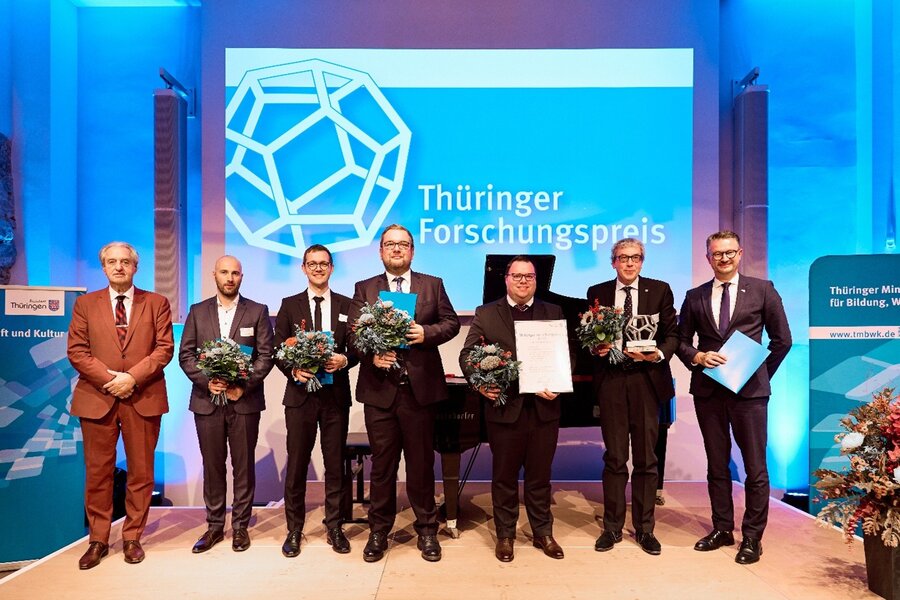
For this achievement, Prof. Dr.-Ing. Klaus Schricker, Head of the Joining and Welding Technology chair at the BTU, together with Prof. Jean Pierre Bergmann, Dr Leander Schmidt, Dr Falk Nagel and Martin Stambke from the Technical University of Ilmenau, were presented with the Thuringian Research Prize in the ‘Applied Research’ category at Weimar City Palace on 27 October 2026.
Fewer spatters, less scrap
When welding with high-power lasers, small droplets of molten metal are ejected from the molten pool. These spatter droplets lead to material loss, impair the properties of the workpiece and necessitate costly rework.
Using high-speed X-ray imaging at the European Synchrotron Radiation Facility (ESRF) in Grenoble, France, the research team led by Prof. Klaus Schricker and Prof. Jean Pierre Bergmann succeeded in visualising the processes responsible for this phenomenon inside the workpiece. Together with further research, including flow simulations, this has resulted in the first comprehensive model of spatter formation and the mechanisms by which targeted countermeasures work.
The resulting measures, including an adapted laser beam shape and precisely aligned gas nozzles, reduce material loss due to spatter by more than 90 per cent. For the manufacturing industry, this means less scrap, less rework and more sustainable production.
Understanding the fundamentals enables solutions that can also be applied to other materials, components and systems. Basic research thus makes a decisive contribution to translating scientific findings into robust industrial manufacturing processes.
“When welding with high-power lasers, the causes of defects such as spatter lie where they cannot be seen: inside the workpiece. Making these processes visible is the key to understanding their mechanisms and then specifically improving welding processes,” says Prof. Schricker
Joint success for Ilmenau and Cottbus
Prof. Schricker received the award jointly with the team led by Prof. Jean Pierre Bergmann from the manufacturing technology chair at the University of Technology of Ilmenau. Until August 2024, he headed the Laser Material Processing research group there, where the award-winning work was carried out. He now chairs the Department of Joining and Welding Technology at the BTU Cottbus-Senftenberg, where he contributes his expertise in research and teaching. The award highlights the BTU’s profile in manufacturing technology and its role as a partner for academia and industry.
The Thuringian Research Prize was awarded in 2026 to a total of three teams in the categories of Basic Research and Applied Research.
Subject specialist
Contact