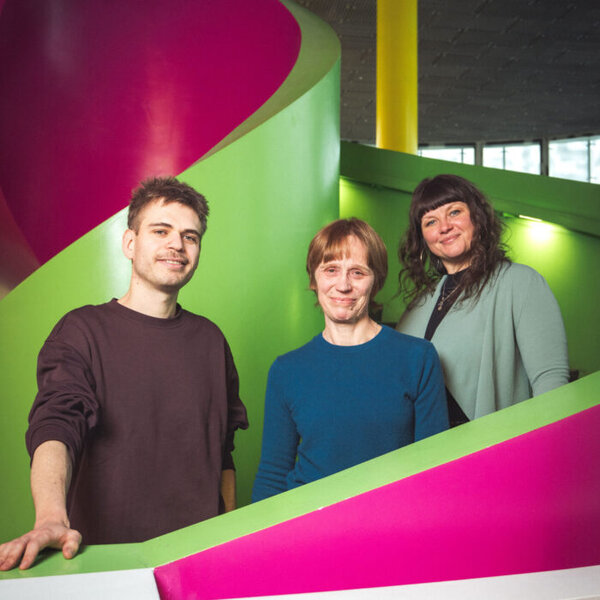
How BTU research is rethinking healthy ageing in Lusatia
Together with local stakeholders, researchers are investigating how older people can become more actively involved and shape a self-determined, meaningful life in old age.
The positive example of Grit Berecz clearly illustrates just how practical the aims of AlterPerimentale are: for her, retirement is not a retreat. She regularly volunteers as a mediator at a primary school in Cottbus. When children find themselves in conflict, she listens to them and helps them find solutions for themselves. She is part of the ‘Seniorpartner in School’ association, whose volunteers bring their life experience to everyday school life and support teachers in conflict mediation. In doing so, they work closely with teaching staff.
So far, Grit Berecz has been working alone, although the ‘Seniorpartner in School’ concept envisages a tandem of two mediators. She sought support from the Cottbus Centre for Applied Research at the BTU. What began as a specific question and an idea has become the subject of joint research, which centres on how to encourage more older people to get involved in this kind of work. In the process, Grit Berecz herself has become a co-researcher. She contributes her experiences and perspectives to the academic work.
Grit Berecz’s story exemplifies how this research approach works: a specific challenge in everyday school life gives rise, in collaboration with a committed member of the community, to a research question of regional significance. In this way, academia becomes a driving force for social participation and healthy ageing in Lusatia.
Enabling engagement and addressing social barriers
“If you want to encourage more older people to take up voluntary work, you need to start early – ideally before they leave the workforce, say from the age of 55. People who are only approached at the age of 70 or 75 have often already found other ways of organising their daily lives,” explains BTU researcher Richard Pantzier from the Regional Planning chair and the Cottbus Centre for Applied Research.
At the same time, volunteering must be open to as many people as possible, regardless of their time, health or social resources. This is because volunteering can promote healthy ageing, but must neither place an excessive burden on people nor replace a lack of public services. School mediation is therefore intended as a complement to, not a replacement for, school social work.
Information stand on the topic on 21 November 2026 at BLECHEN Carré
Anyone interested in this form of volunteering has the opportunity to find out more: on Saturday, 21 November 2026, the ‘Seniorpartner in School’ association will be running an information stand at the BLECHEN Carré in Cottbus to provide details on training to become a mediator. Grit Berecz will also be there to share her experiences. This short film offers a vivid insight into the association’s work and the added value of school mediation: https://vimeo.com/791117465?fl=pl&fe=sh.
Research in collaboration with practice
The Centre for Applied Research differs from traditional social research through its participatory approach: findings are developed together with local people, tested in practice and reflected upon. Academia and everyday life meet on equal terms. The focus is on socio-technical, socio-ecological and socio-spatial innovations, which older people actively help to develop.
This also addresses far-reaching societal questions: How do demographic change and structural change affect rural areas? Which local resources and structures enable participation and healthy ageing? Where do gaps in provision and structural disadvantages arise? And how can local stakeholders develop new forms of collaboration?
Richard Pantzier researches the challenges facing rural areas in eastern Germany: these include an ageing population, tight public finances, a depleted social infrastructure and the risk of increasing loneliness due to younger people moving away. The aim of his research is to highlight existing potential and to investigate and reduce structural disadvantages.
A model for the entire region
The ‘AlterPerimentale’ transfer initiative – a play on words combining ‘Alter’ (age), ‘Peripherie’ (periphery) and ‘Experiment’ – applies this approach to rural areas along the German-Polish border. It covers the districts of Oder-Spree, Spree-Neiße and Görlitz, as well as Cottbus. The aim is to work with local stakeholders to develop innovations that enable older people to lead self-determined lives.
Funded by the Federal Ministry of Research, Technology and Space, the initiative is supported by the BTU Cottbus-Senftenberg, the Catholic University of Applied Social Sciences Berlin and the Heinersdorf Centre for Applied Research. The practical research centres in Heinersdorf, Cottbus and Görlitz serve as spaces for reflection and experimentation. The initiative was recently confirmed for a second, three-year funding period.
Contact
Press contact