
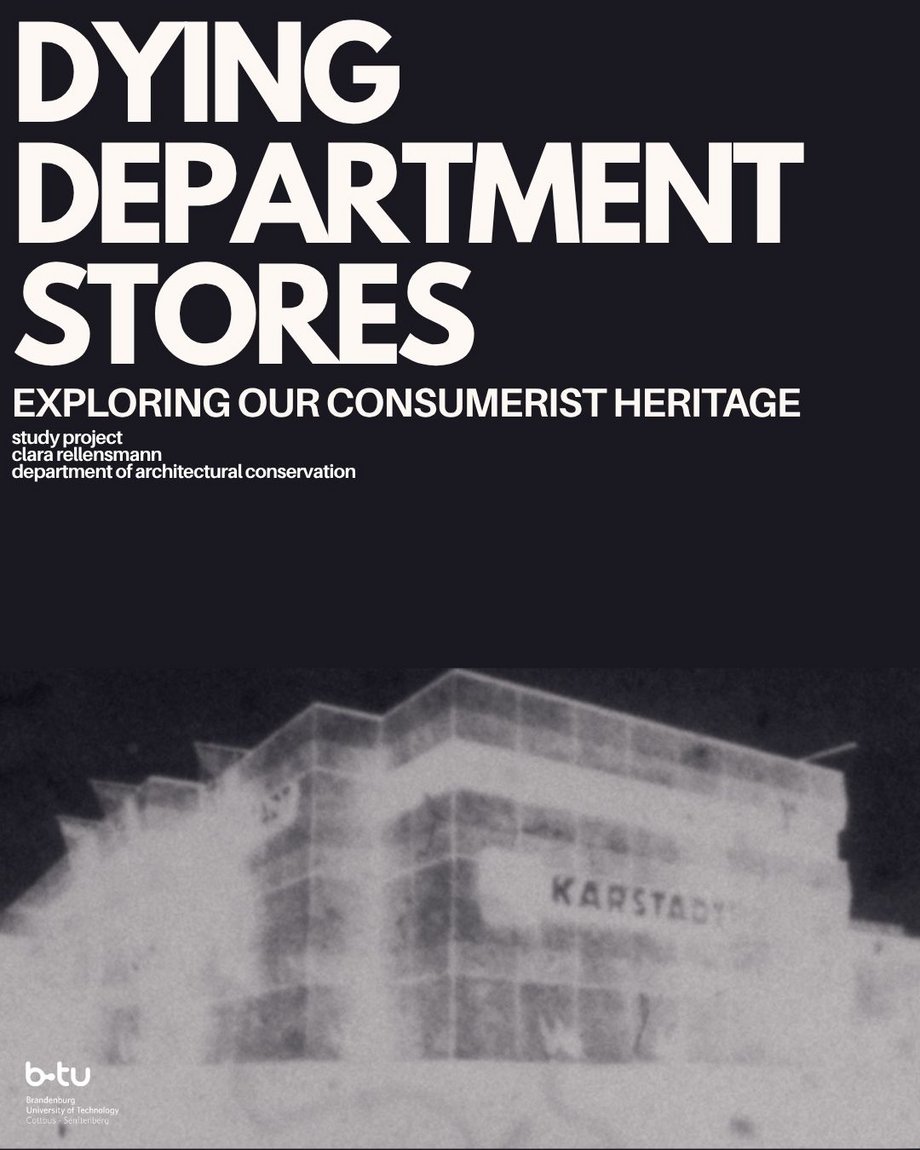
Consumerist Heritage
The starting point of the research project is the widespread phenomenon of dying department stores around the world which is closely linked to the global rise of e-commerce that was drastically accelerated with the Covid-19 pandemic. In Germany, the changed consumer behavior has created a landscape of large-scale capitalist ruins in monofunctional city centres. The ongoing loss of department-store culture and its built manifestations calls for a critical assessment from the perspectives of heritage and conservation with a view to making contributions to the informed, socially responsive, and sustainable treatment of these buildings. The research project investigates trends and challenges involved in the preservation and adaptive-reuse of these obsolete typologies and explores these post-war and late modern architectures of consumerism as future heritage.
Research-led teaching projects
Dying Department Stores, Summer Semester 2025 (12 ETCS)
Study project explored the concept of consumerist heritage from a global perspective by defining terms and concepts related to the broader subject of consumerist architecture and by analyzing dying department stores from different contexts around the world. The project drew on literature from heritage studies, conservation history and theory to establish a heritage-lens through which the students documented, described and assessed young consumerist architectures (1960s and younger) that have lost their original function(s).
Invited guest lectures and inputs
- “Department Stores + Parking Garages”, Luise Rellensmann (Hochschule München)
- “Creative Place-Making: New World X Old Town” Supitcha Tovivich (Silpakorn University)
- „Occupied Potential: Re-imagining Large Structures through Use, Beauty and Political Imagination”, Dilan Vural (Technische Universität München)
- „Failed Consumerist Architectures“, excursion to Halle (Saale) with Albrecht Wiesener (CIEE)
Obsolete Typologies // Future Monuments, Winter Semester 2025/2026
In this study project, department stores of the late modern era were framed as cultural-historical testimonies to an era of expansive consumerism and as spaces offering possibilities for vibrant heritage futures. Case studies from Berlin were analyzed asking what insights into shifting heritage values can be drawn from varying conditions of these buildings, as well as from their on-going processes of adaptive re-use and transformation?
Case studies included amongst others the former C&A buildings in Neukölln and Alt-Tegel, as well as, (former) Karstadt buildings at Hermannplatz (Neukölln) and Leopoldplatz (Wedding)
- “Temples of Consumption”, Lea Engel (formerly BTU, WHS)
Supervision of related master theses
Marie Höppner: Consumer Heritage in Transition: Obsolescence, Heritage Values and Transformation in the Heritage Area of Leipziger Straße, Halle (Saale) (Working Title)