
Housing as Experience: Between Security, Change and Urban Transformation
Dr. Carolin Genz is an associated postdoctoral researcher in the DFG Research Training Group "Gewohnter Wandel"– one of the most significant current German research consortia addressing the housing question. Her work brings together urban geography, anthropology, and urban design into a decidedly interdisciplinary approach that engages critically with contemporary debates on housing, space, and societal transformation. At the centre of her research stands the project "Ontological (In)Securities of Housing", which examines how residents constitute and negotiate their subjective housing experiences under conditions of accelerated urban change, including gentrification, the financialisation of housing, and infrastructural restructuring.
The project takes as its starting point the entanglement of global capital logics with locally embedded housing practices, as theorised in debates on planetary gentrification and extended urbanisation. Drawing on concepts of ontological security, feminist urban theory, and psychoanalytically informed approaches to housing research, it investigates how insecurity is produced, embodied, and articulated as a spatial-affective experience. Housing is understood here not as a mere backdrop to socio-spatial processes, but as an actively produced, contested, corporeally grounded, and existential practice – a site of belonging and loss, of stability and threat.
By systematically linking affective and embodied dimensions of housing to political-economic transformation processes, the project positions itself at a productive intersection of critical housing research, feminist urban theory, and ethnographic methodology. The use of qualitative and visual methods contributes to the ongoing methodological development of urban research.
Current Project: Ontological (In)Securities of Housing: Psychoanalytic and Feminist Perspectives on Subjective Housing Experiences in Urban Transformation Processes
Institution: Goethe University Frankfurt/Main (Institute of Human Geography, Prof. Dr. Sebastian Schipper)
Funding Framework: DFG Research Training Group "Gewohnter Wandel – Gesellschaftliche Transformation und räumliche Materialisierung des Wohnens" (GRK 2892/1)

DFG Research Training Group "Gewohnter Wandel: Societal Transformation and Spatial Materialization of Housing“
The DFG Research Training Group "Gewohnter Wandel", hosted jointly by Goethe University Frankfurt/Main and Bauhaus-Universität Weimar, addresses a question that is as fundamental as it is urgent: How is housing changing? And what do these changes reveal about contemporary society? The group proceeds from the observation that housing, as a universal human practice, renders societal transformation processes visible in ways few other domains of everyday life can match. It examines the profound transformation to which housing is currently subjected under conditions of globalised, financialised, and flexibilised capitalism – from the individualisation of housing forms and the emergence of new ownership structures to shifting residential biographies. Research is organised along three thematic fields: subjective housing practices in everyday life; the social organisation and regulation of housing; and questions of production, financing, and management of residential space.
Further information on the Research Training Group, its current research strands, and upcoming events is available at: gewohnter-wandel.de
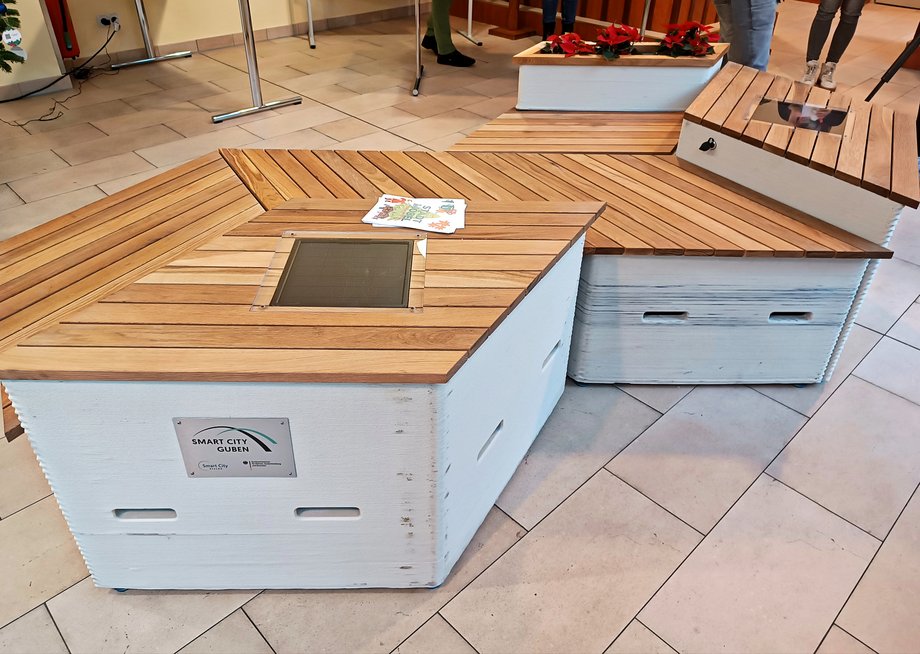
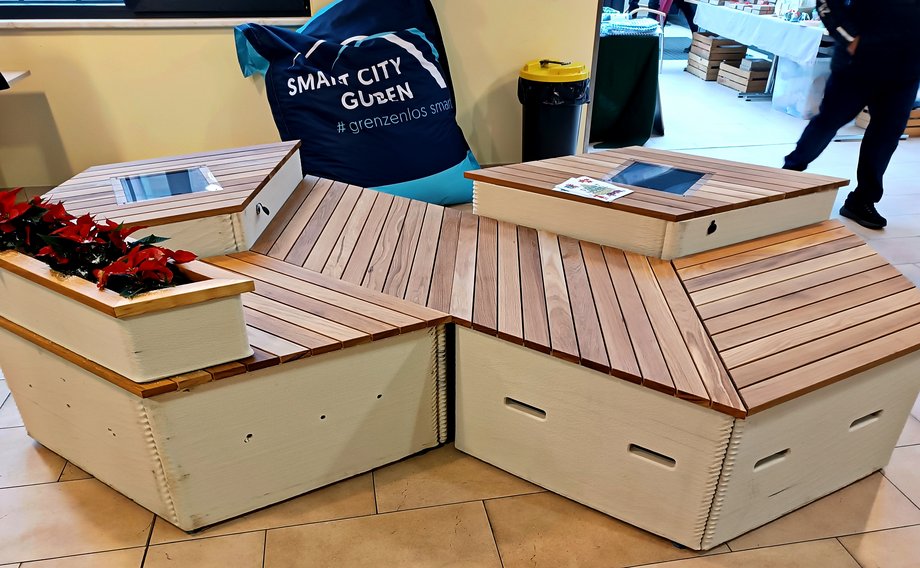
Smart-City-Project "Gubenwabe"
The Smart-City-Project presented its new street furniture for the first time at the Christmas market in Guben on December 13, 2025. The prototype presented was the modern "Gubenwabe" seating, which consists of three elements that can be combined to form a hexagon and has an integrated table surface. A solar panel enables mobile devices to be charged directly on site.
The street furniture subproject was launched in 2024 as a collaboration between school students from Guben, departments and staff at BTU Cottbus–Senftenberg, and Holzart GmbH Guben. According to the city of Guben on relevant social media channels, the Gubenwabe is thus a prime example of participation, sustainability, and innovation within the Smart-City-Project.
A combination of wood technology and 3D printing processes was used in its manufacture. The seating will be tested as new street furniture in public spaces in the future in order to gain experience in terms of functionality, acceptance, and technical equipment.
Smart Guben
Spaces and qualities for young people to spend time in Guben's urban space
Where do young people spend time in the city? What conditions, needs and conflicts exist in these places and how can new street furniture improve the quality of their stay? A collaboration between the Chair of Urban Design and Urban Studies at BTU Cottbus-Senftenberg, the Smart City project of the city of Guben and Pestalozzi-Gymnasium Guben will be taking place in summer 2024 to answer these questions. The focus is on the public spaces and meeting places used by young people in Guben as well as the requirements and wishes regarding the design of these spaces.
During the summer semester, an impromptu seminar is offered with Master's students of Urban and Regional Planning and Architecture. In May, an initial city tour and discussion on current urban development took place with Mayor Fred Mahro and employees of the city administration. This was followed in July by a joint working day with pupils from the geography course at Pestalozzi-Gymnasium. With the help of on-site inspections, interviews and the mapping method, the everyday spaces of young people in the city were examined in order to identify characteristics for the design of these spaces and to create the basis for designs for street furniture.