
MONES - Mathematical Methods for the Optimization of District Heating Networks and Geothermal Storages

General information
Project BMBF-Förderschwerpunkt "Mathematik für Innovationen"
Duration 2022 bis 2025
Project managers
Prof. Dr. Ralf Wunderlich (Koordinator), Prof. Dr. Gerd Wachsmuth,
Project parners
Prof. Dr. Nicole Bäuerle (KIT Karlsruhe)
eZeit Ingenieure GmbH, Berlin
hartig & ingenieure, Gesellschaft für Infrastruktur- und Umweltplanung mbH, Chemnitz
Project description
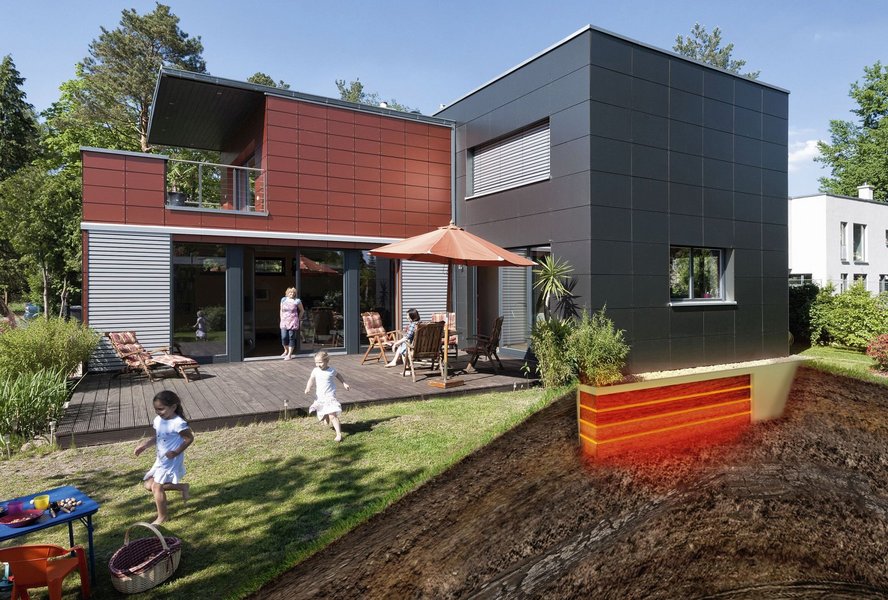
The production of thermal energy is currently largely based on burning fossil fuels which leads to an significant amount of CO2 emissions. The energy transition and decarbonization of the economy can only succeed if in addition to the electricity production also the heat supply is transformed. The contribution of renewable energies such as solar heat and geothermal energy has to be increased. The generation of heat from renewable energies is subject to strong seasonal and weather-dependent fluctuations. Further, it is often decentralized. This requires a suitable temporal and spatial balance of supply and demand. For this reason a new generation of heating networks, the so called cold district heating networks, as well as geothermal storages play an important role.
Our industry partners are engaged in the design and operation of such heating networks and storage facilities. In the planning and design as well as in the evaluation of the economic efficiency of such systems, they enter new territory in many places and often have to work with ad hoc approaches. This concerns the complex charging and discharging behavior of a geothermal energy storage system, questions about a suitable shape, insulation and size of these storage systems, an efficient spatial arrangement of the heat exchangers, the cost-optimal and anticipatory control of heating systems equipped with thermal energy storage systems, as well as their design, control and management.
In order to provide well-founded answers to the questions raised, the project will involve mathematical modeling and the development of digital twins of the aforementioned energy systems. While our academic partner KIT focuses on issues related to district heating networks, our project will investigate the simulation, optimization, and control of heating systems equipped with geothermal energy storage systems. Mathematical problems from shape optimization and stochastic optimal control are analyzed and solved using methods from numerical analysis and machine learning.
Project-related publications
E. Pilling, M. Bähr, R. Wunderlich
Reinforcement Learning Methods for the Stochastic Optimal Control of an Industrial Power-to-Heat System
Energies, 19, 1046, 2026
P.H. Takam, R. Wunderlich:
Cost-optimal management of a residential heating system with a geothermal energy storage under uncertainty.
International Journal of Dynamics and Control, 13, 424, 2025
Paul Honore Takam, Nathalie Fruiba
Stochastic Optimal Control Problems for the Cost-Optimal Management of a Standalone Microgrid
arxiv.org/abs/2511.00167 [math.OC] 2025
P.H. Takam, R. Wunderlich
Numerical Simulation of the Input-Output Behavior of a Geothermal Energy Storage.
Energies, 18, 1558, 2025
E. Pilling, M. Bähr, R. Wunderlich
Stochastic Optimal Control of an Industrial Power-to-Heat System with High-Temperature Heat Pump and Thermal Energy Storage.
arXiv:2411.02211 [math.OC] 2024
P.H. Takam, R. Wunderlich: Model order reduction for the input–output behavior of a geothermal energy storage.
Journal of Engineering Mathematics (2024) 148:12
P.H. Takam, R. Wunderlich, O. Menoukeu Pamen: Modeling and simulation of the input–output behavior of a geothermal energy storage. Mathematical Methods in the Applied Sciences,
47(1), 371-396, 2024
P. H. Takam, R. Wunderlich: On the Input-Output Behavior of a Geothermal Energy Storage: Approximations by Model Order Reduction.
arXiv:2209.14761 [math.NA] 2022
P. H. Takam, R. Wunderlich, O. Menoukeu Pamen: Short-Term Behavior of a Geothermal Energy Storage: Modeling and Theoretical Results.
arXiv: 2104.05005 [math.NA] 2021
P. H. Takam, R. Wunderlich, O. Menoukeu Pamen: Short-Term Behavior of a Geothermal Energy Storage: Numerical Applications.
arXiv:2104.05116 [math.NA] 2021