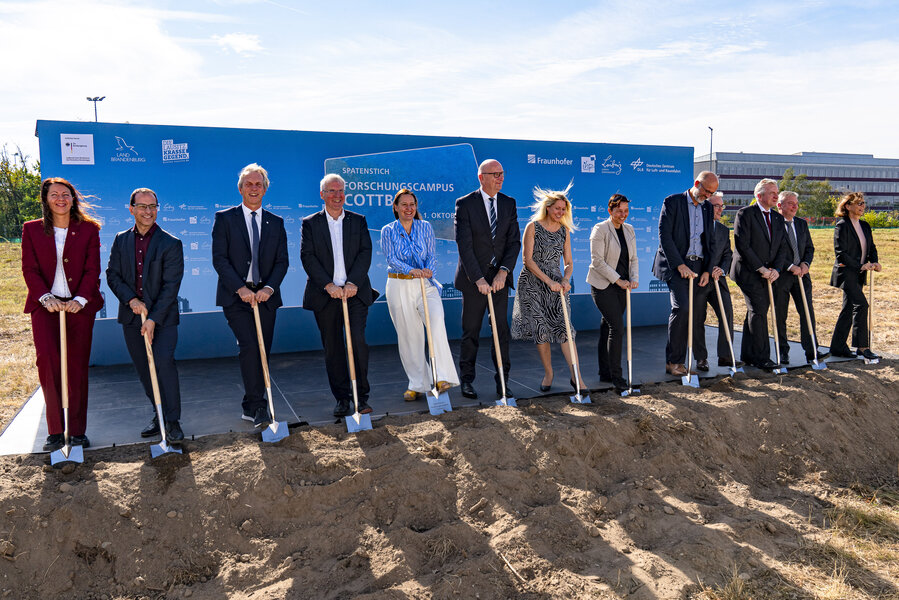
New research campus in Cottbus: BTU secures strong non-university partners for research and knowledge transfer
Minister-President Dr Dietmar Woidke, Parliamentary State Secretary at the Federal Ministry of Research Dr Silke Launert and Minister for Science Dr Manja Schüle presented funding notifications to the German Aerospace Centre (DLR), the Fraunhofer Society and the Leibniz Association.
Strong partners for the BTU: research and technology transfer under one roof
With the new campus, Cottbus is gaining high-calibre partners for the Brandenburg University of Technology Cottbus-Senftenberg (BTU) from three of Germany’s leading research organisations: the German Aerospace Centre (DLR), the Fraunhofer Society and the Leibniz Association. Joint professorships, research projects and collaboration in teaching and knowledge transfer are already in place and will be expanded with the new campus.
The research campus will be home to the DLR Institute for Low-Carbon Industrial Processes, the DLR Institute for Electrified Aero Engines, the Fraunhofer Institute for Energy Infrastructures and Geotechnologies (IEG), the Fraunhofer Institute for Photonic Microsystems (IPMS) and the Leibniz-Institute for Innovations for High Performance Electronics (IHP). The range of topics extends from climate-neutral industry, through electric flight and geoenergy, to Microelectronics and sensor technology. The institutes thus cover key priority areas at the BTU: global change and transformation processes, the energy transition and decarbonisation, health and life sciences, and Artificial Intelligence and sensor technology.
This alignment is no coincidence. Numerous researchers from the institutes also teach at the BTU: Prof. Harald Schenk from Fraunhofer IPMS holds the Chair in Micro- and Nanosystems; Prof. Gerhard Kahmen from the Leibniz Institute IHP heads the Semiconductor Technology chair; and Prof. Mario Ragwitz from Fraunhofer IEG heads the chair for Integrated Energy Infrastructures.
Prof. Dr Gesine Grande, president of the BTU, says: “The research campus is creating sustainable structures for close cooperation between the BTU and non-university institutions. We are already participating in joint collaborative projects in the priority areas of the energy transition and decarbonisation, as well as Artificial Intelligence and sensor technology. We aim to develop Cottbus into an internationally recognised centre of science that contributes to the success of the region’s transformation.”
A symbolic appointment
Last week’s election illustrates just how closely the university and non-university research are linked. On 24 September, the BTU’s Senate elected Prof. Dr Uwe Riedel as Vice President for Research and Transfer. Riedel was most recently a professor at the BTU and Director of the DLR Institute for Low-Carbon Industrial Processes in Cottbus and Zittau – one of the institutions currently building on the Nordring. Grande was confirmed for a second term in mid-September.
Prof. Dr Uwe Riedel, designated Vice President for Research and Technology Transfer at the BTU: “I have gained first-hand experience of both sides: basic university research and application-oriented research at a non-university institute. Their strength comes to the fore when both work together to develop ideas and bring them right through to the companies. Research, transfer and joint development go hand in hand. On this campus, we can consistently develop and complete this chain together with our partners.”
The Future of Science
Politically, the project is underpinned by a commitment: structural change funds are to have a lasting impact in Lusatia. All the institutions involved in the construction are part of the Lusatia Science Network, which now comprises 15 scientific institutions in Lower Lusatia. The campus is a visible building block of the growing science and innovation landscape, which also includes the Lausitz Science Park (LSP) near the campus. The BTU is developing this science-driven technology hub in collaboration with the City of Cottbus and WISTA, which also operates the Adlershof Technology Park.
For the students – more than 2,000 of whom have just started the 2026/27 academic year – the campus is becoming a tangible part of this development: it is taking shape before their very eyes and will later become a place of learning, a research environment and a workplace. On Thursday, the project kicked off with a ground-breaking ceremony, a group photo and a get-together.
Contact