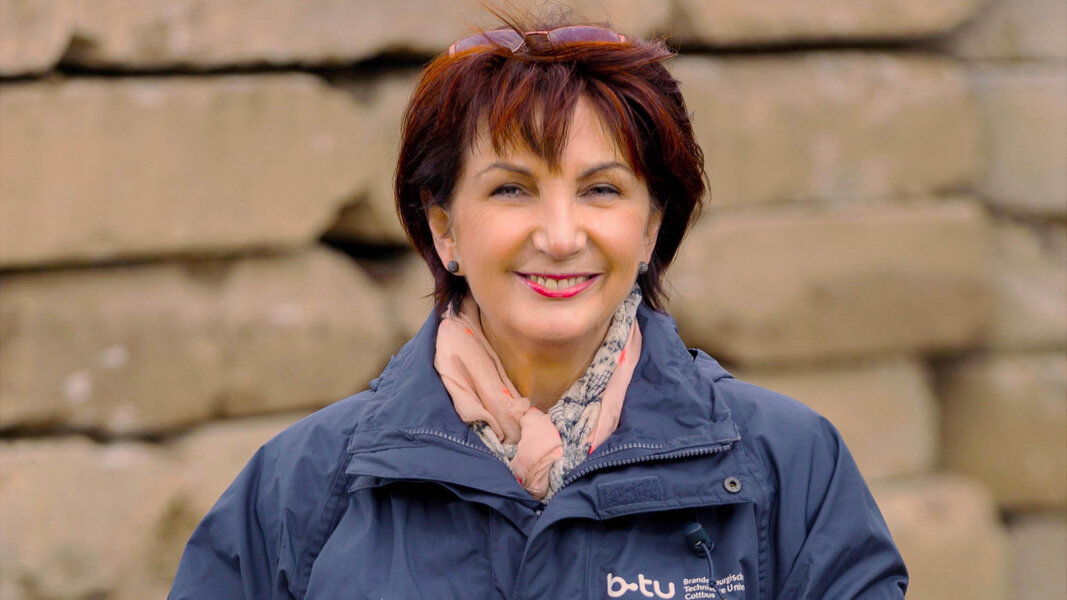
She saves what others destroy
Weighing up to six tonnes, six metres long and, in effect, doomed. That is what the concrete slabs looked like after partial demolition; they had once been used in a block of flats in Großräschen before most of them were crushed on site. Most people regard them as rubble. For Angelika Mettke, they are intact concrete slabs; they are building materials. Today, they form the structure of a clubhouse in Kolkwitz, 30 kilometres away – wall by wall and ceiling by ceiling, rebuilt as if nothing had happened. This is precisely Mettke’s life’s work: concrete slabs that were actually destined for the crusher are given a second chance by her.
An idea 30 years ahead of its time
When Angelika Mettke began researching the reuse of precast concrete elements in the 1990s, hardly anyone had heard of the term ‘Circular Economy’. Today, it features in every climate debate, and Mettke suddenly finds herself at the heart of an issue she was already working on when no one took it seriously.
Her core argument is as simple as it is irrefutable: “Gravel, sand, limestone and clay do not grow back.” Every tonne of concrete that is saved is a tonne that nobody has to extract from the ground. For this visionary, the real scandal is not building with reused materials, but the thoughtless demolition that takes place every day in Germany.
97 per cent – a figure worth remembering
Mettke has calculated that up to 97 per cent of CO₂ emissions can be saved by using recycled building materials instead of newly produced ones. To put this into perspective: this isn’t just a matter of building a little bit greener – it’s a figure that could transform an entire industry, were it taken seriously.
This is precisely what the BTU professor is working on in the European research project “ReCreate”: standards, digital tools, processes – so that a single idea can become a system. Kolkwitz is not merely a symbolic exercise, but a practical test, taking place live on the building site.
The catch: there is simply no market for it
As convincing as the idea is, day-to-day reality remains a struggle. Anyone looking for used building components often ends up directly at Mettke’s department due to a lack of alternatives – a situation she herself describes as untenable. Her team is therefore simultaneously developing something that is virtually non-existent in Germany: a genuine marketing platform for used building components. The start-up Greyloop, founded in September 2026, is intended to overcome this obstacle. After all, a good idea is of little use if there is nowhere for supply and demand to meet.
Award-winning, but still a long way from the finish line
The expert community has responded, albeit belatedly: in 2016, she received the German Environmental Prize – one of the highest honours of its kind in Germany. In June 2017, she received the ‘25 Women for a Better Environment’ award in Berlin, and in October 2025, the Swedish Concrete Award in Stockholm, in recognition of her life’s work. Three prizes, three decades apart, and in between a researcher who simply carried on, even when hardly anyone was paying attention. Now another accolade has been added to the list: *Der Tagesspiegel* honours Angelika Mettke as part of its annual series “The 100 Most Important Figures in Berlin Science” – a feature through which the editorial team has, since 2023, been showcasing researchers from the capital region who make an impact through outstanding achievements, excellent teaching or social commitment.
Why it matters now
Angelika Mettke’s research is now addressing a construction industry under pressure: scarce raw materials, climate targets, rising costs. Her response sounds almost too simple to be true – and is all the more convincing for it: you don’t always have to invent something new. Sometimes it’s enough to take a closer look at what’s already there.
Contact