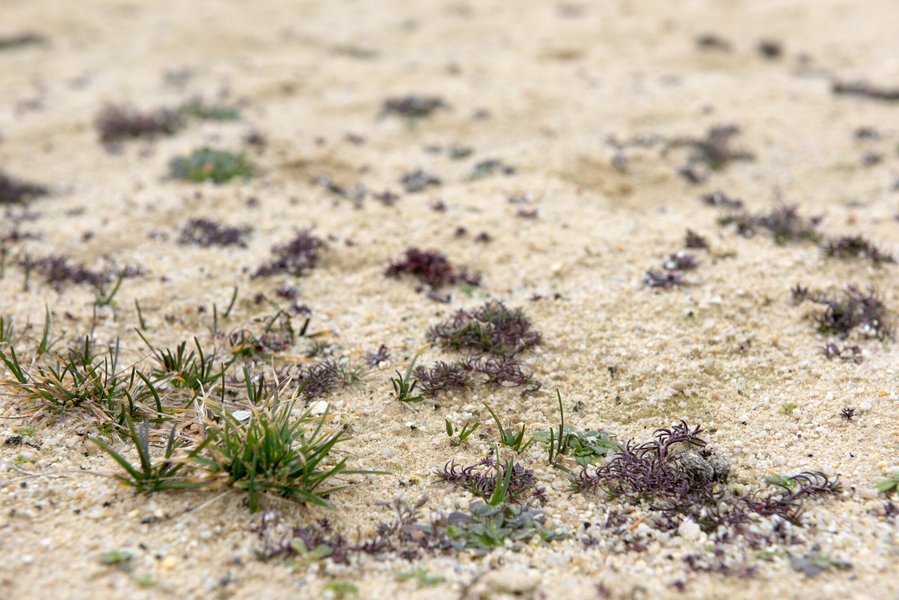
Hemp defies drought: Sustainable harvest possible on barren soils in Brandenburg
Researchers from BTU and TU Braunschweig have shown that industrial fibre hemp can be grown successfully even under extremely dry and nutrient-poor conditions. The latest study, published in the International Journal of Environmental Research, sheds light on the potential of the hemp variety Santhica 27 for sustainable agriculture in sandy soils in Brandenburg.
With increasing drought in Brandenburg, industrial hemp, Cannabis sativa L., could serve as a model plant for climate-adapted agriculture - with positive effects for soil fertility, CO₂ sequestration and new economic opportunities.
Main findings of the study:
- Drought resistance: hemp developed a distinct root system despite water deficits of 169 mm during the growing season, which contributed to more efficient nutrient uptake.
- Optimal planting density: Lower planting densities (71 plants/m²) funded larger plants, thicker stems and higher biomass and fibre yields, while high densities led to higher thinning in drought conditions.
- Climate-friendly & versatile: The fast-growing, deep-rooted crop binds carbon in the soil and can strengthen Brandenburg's bioeconomy as a fibre and biomass plant.
"Our results show that hemp can be grown economically and ecologically even on poor, sandy soils - especially in times of increasing droughts," says Agne Matvejeva, a scientist at the BTU Chair of Aquatic ecology.
"Plant density in particular plays a decisive role: less dense stands survive dry periods better and at the same time deliver higher yields," adds Thomas Raab, BTU Chair of Geopedology and Landscape Development. "This opens up new perspectives for climate-adapted agriculture in Brandenburg."
The study was carried out in close collaboration with Magdalena Sut-Lohmann and Martina Heinrich from the Institute of Geoecology at the University of Technology in Braunschweig.
Publication:
Matvejeva, A., Sut-Lohmann, M., Raab, T., Heinrich, M. (2026). Assessing the Possibility to Cultivate Industrial Hemp (Cannabis sativa L.) in Sandy Agricultural Soils of Brandenburg under Water Scarcity and Nutrient Deficiency. International Journal of Environmental Research, 20, 71 [Open Access].
Contact us
Press contact