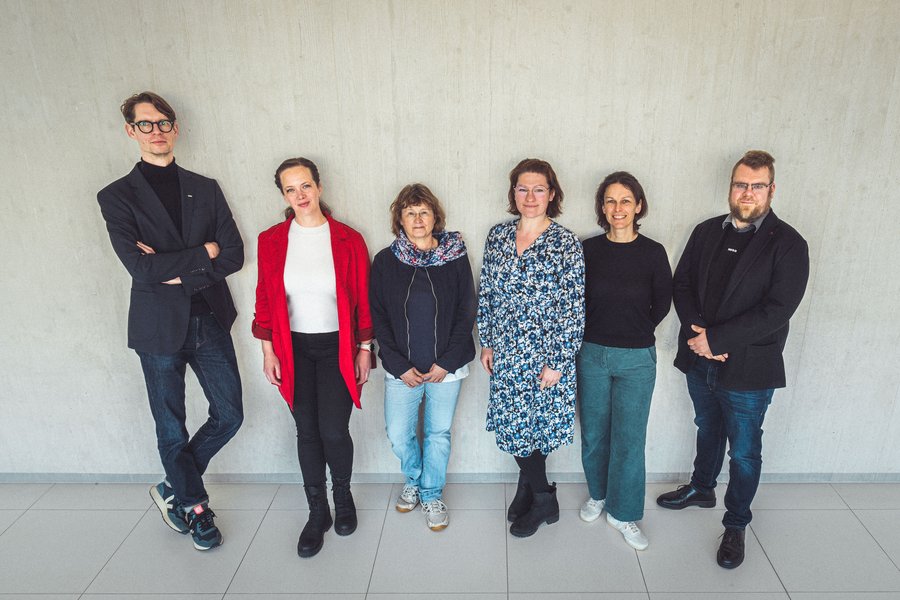
Three new perspectives on structural change – an interview with the officers for the profile lines
Dr Wilde, Dr Henrich-Noack, Dr Steinmetzer – what professional backgrounds do you bring to BTU?
Dr Jessica Wilde: My background is in general sociology, with a focus on urban, spatial and technological sociology. Following positions at Philipps University of Marburg and, most recently, as a postdoc at Leuphana University Lüneburg, I have also worked in project management within urban development. This combination of academia and practice continues to shape my perspective to this day.
Dr Petra Henrich-Noack: My career began in pharmacy, followed by doctoral studies in neuropharmacology. I then worked in research and science management both in Germany and abroad, in particular in the neurosciences and digitalisation in medicine.
Dr Tobias Steinmetzer: I am a computer scientist and during my doctoral studies, I focused on AI-supported classification of Parkinson’s disease stages. Since then, I have been involved in various interdisciplinary research projects at the BTU, in particular at the interface between Computer Science and medicine.
What are your main responsibilities as profile line coordinators?
Wilde: I see my role primarily as making connections visible – between topics, disciplines and people. It is about creating formats and structures that enable interdisciplinary collaboration.
Henrich-Noack: For me, the focus is on bringing researchers together, funding collaborations and identifying new funding opportunities. At the same time, I want to create space for innovative ideas to emerge, including with external partners such as the MUL-CT.
Steinmetzer: At the moment, I’m mainly helping to establish collaborations and develop joint projects. This also includes networking and preparing funding applications.
What particularly appealed to you about this position?
Wilde: I find the opportunity to view transformation not just in theory, but to help shape it in practice in Lusatia, particularly exciting – as is the interdisciplinary collaboration.
Henrich-Noack: What motivates me most is actively supporting research and driving ideas forward together with researchers. Developing creative solutions in the process is what makes it so appealing to me.
Steinmetzer: I deliberately wanted to go beyond traditional research. The diversity of topics and the opportunity to support new project ideas immediately appealed to me.
What experience do you bring to your new role?
Wilde: I have learnt to work with different stakeholder groups and to actively shape interfaces – that is precisely what is crucial here too.
Henrich-Noack: Alongside my enthusiasm for science, I bring experience and insights from universities, non-university research institutions and companies.
Steinmetzer: Thanks to my interdisciplinary work, I’m well placed to bridge the gap between different departments and forge new connections.
What do your research profiles focus on – and which topics are particularly important to you?
Wilde: The ‘Global Change and Transformation Processes’ profile focuses on the transformation of spaces – from cities to global contexts. I find the interplay of ecological, social and technological perspectives particularly fascinating.
Henrich-Noack: Our research profile ‘Health and Life Sciences’ deals, among other things, with digital healthcare, biomedicine and new active substances. It is important to me to create new opportunities for research and knowledge transfer in this area.
Steinmetzer: The ‘Sensor Technology and AI’ research area brings together expertise in Microelectronics and Computer Science and supports other fields as a cross-disciplinary profile. This interconnection is a key building block for innovation.
Is there anything personal you’d like to share?
Wilde: I’m particularly looking forward to developing new ideas together with others and making things happen.
Henrich-Noack: As well as work, I hope to find good conditions for stand-up paddleboarding in Lusatia.
Steinmetzer: I have strong ties to the region; I’m originally from Finsterwalde and am delighted to now be able to continue contributing to its development here.
With their diverse perspectives and a shared understanding of collaboration, the three new officers are providing important impetus for the further development of the strategic priorities – and thus for structural change in Lusatia.
Contact
Referat Strukturwandel
T +49 (0) 355 69-3846
johannes.staemmler(at)b-tu.de