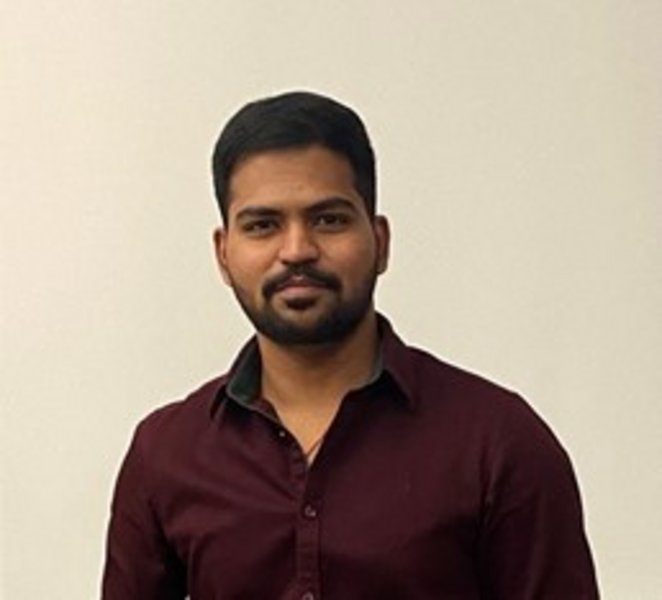
Interview with BTU Alumnus Muthu Kumaran Parthiban
How did you end up studying in Senftenberg, and what was your experience there like, especially focusing on Bioanalytics?
After completing my Bachelor's degree in Biotechnology at an engineering university in India, I decided to pursue my Master's in Germany because of its strong research and technical education. I wanted to study at a technical university with a practical focus and after exploring different programs, BTU Cottbus–Senftenberg stood out because of its lab-oriented curriculum. I specialized in Bioanalytics, where I learned about the interactions of proteins, metabolites, nanoparticles and xenobiotics in the human body. The program included three practical laboratory courses along with theoretical subjects. These practical courses taught how analytical technologies can be applied to biological research. It gave me hands-on experience with analytical techniques such as chromatography, mass spectrometry and protein analysis. I appreciate that the emphasis was on practical laboratory training rather than just theory.
You completed an English-language master’s program at BTU in Senftenberg. We know that it is not always easy to get by using English everywhere in this region. What was your experience with the language like at BTU and in the surrounding area?
My Master's program at BTU Cottbus–Senftenberg was entirely in English, so academically I never faced any major language barriers. All lectures, laboratory courses, assignments and my master's thesis were conducted in English. The professors and staff were very supportive and the international environment made communication easy. Outside the university, however, German was important for everyday life, especially in a smaller town like Senftenberg. Whether it was visiting government offices, shopping or going to the doctor, I realized that learning German would make life much easier. One thing that really helped me was the free "German as a Foreign Language“ course offered by BTU. These courses helped me build the confidence to communicate in daily situations.
You are working as a Technical Assistant at Leibniz Institute for Natural Product Research and Infection Biology in Jena. What helped you get the job at this high ranked Institue?
I believe what helped me most was the practical knowledge gained during my masters. As I said before, Bioanalytics specialization gave me experience with analytical techniques such as protein purification, LC-MS/MS, chromatography, and biochemical assays. And during my master's thesis, I worked on structural and functional analysis of proteins and metabolites, which strengthened both my technical and research skills. Also, my experience as a Research Assistant at BTU taught me laboratory management, scientific documentation, equipment handling and working in a multidisciplinary team. During the interview, I was able to confidently discuss these experiences which I believe helped me secure the position.
What exactly do you do there, and what is your typical workday like?
I am currently involved in the analytical profiling of metabolites and trace elements associated with the human gut microbiome. My work involves operating analytical instruments such as LC-MS and ICP-MS for sample analysis. Apart from that, I also contribute to laboratory organization, maintaining equipment and preparing samples. I enjoy my daily work and I also enjoy working with my colleagues. They are very friendly, supportive and easy to communicate with, which creates a positive and motivating work environment that I really appreciate.
What advice would you give to international students who are also aiming for a career in Germany?
My advice is to make the most of your time at university, not just academically but also professionally. Focus on gaining practical laboratory experience through internships, research projects and your master's thesis because hands on skills are highly valued by employers in Germany. I would also encourage students to learn German. Even if your program is in English, speaking German makes everyday life easier and opens more career opportunities. Finally, try to be proactive. Attend career fairs, build a professional network, connect with professors, and apply for jobs early.
What do you miss most about your college days?
I think everyone can relate to this, college is one of the most memorable chapters in life. It teaches you much more than academics. It teaches you how to socialize, communicate, work with different people and become more independent. I enjoyed my college days. When I look back, more than missing those days, I look back with gratitude. I was fortunate to have wonderful friends who made my college life memorable, and those friendships and experiences are something I'll always cherish.
Kontakt