Microalgae against cancer: How Lusatia is becoming the health region of the future
One of the most exciting stops was at the Campus Senftenberg of the Brandenburg University of Technology Cottbus-Senftenberg (BTU).
A journey through change
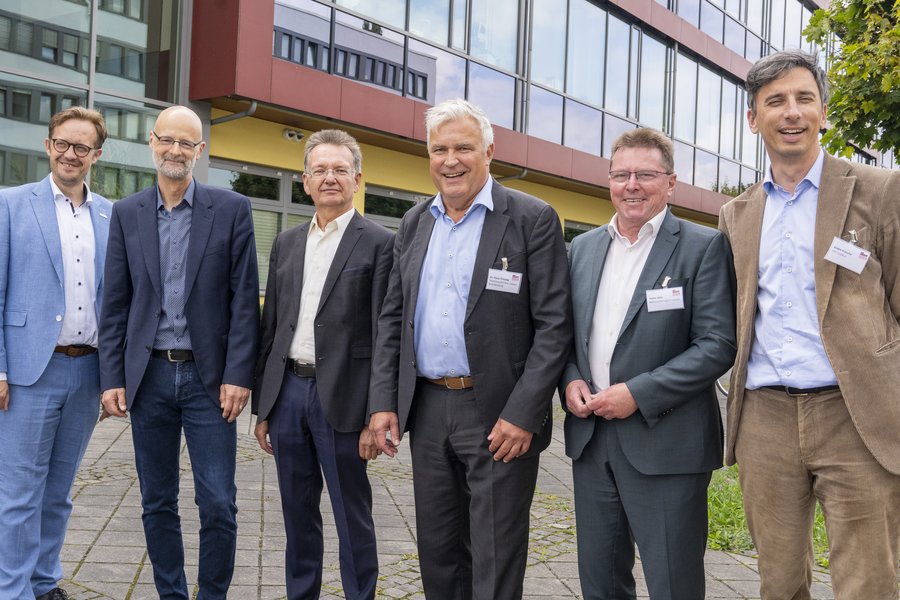
During the media tour organised by the Minister-President’s Lausitz Representative, the itinerary took participants from Lübbenau via Cottbus to Senftenberg and on to Sedlitz Bay. It became clear just how varied the forms of structural change in Lusatia are: from a multi-billion investment in a new Computing Centre to tourism initiatives along the waterfront. Klaus Freytag summed up the region’s dynamism: former energy sites are being transformed into new hubs for digitalisation, research, healthcare and tourism.
A particular focus of the trip was on Lusatia’s development as a healthcare region. Alongside the Medical University of Lusatia – Carl Thiem, which presented its plans for university medicine, research and teaching, and the AI diagnostics start-up IQONIC.AI, one BTU research project in particular caught the attention of the media representatives: AVantiLT.
Senftenberg in the spotlight: When spirulina meets
liver cancer The BTU sees itself as a driving force for innovation in the structural transformation of Lusatia. Since 2021, it has secured funding for over 15 collaborative projects – spread across its four areas of focus: ‘Energy transition and decarbonisation’, “Artificial Intelligence and Sensor Technology”, “Health and Life Sciences” and “Global Change and Transformation Processes”. It is also part of the Lausitz Science Network, which comprises 13 other research institutions, whilst the emerging Lausitz Science Park on the main campus in Cottbus is creating new opportunities for companies to set up and spin off.
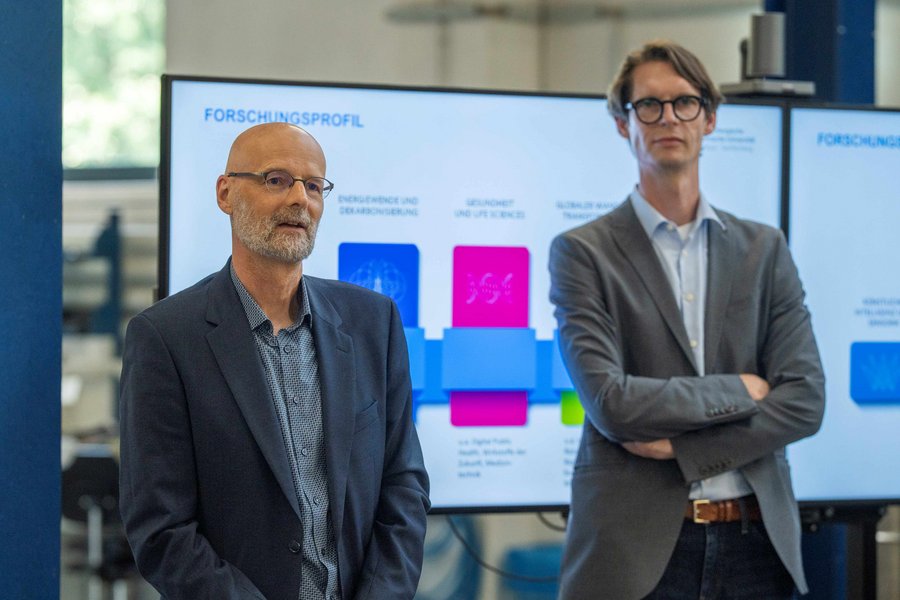
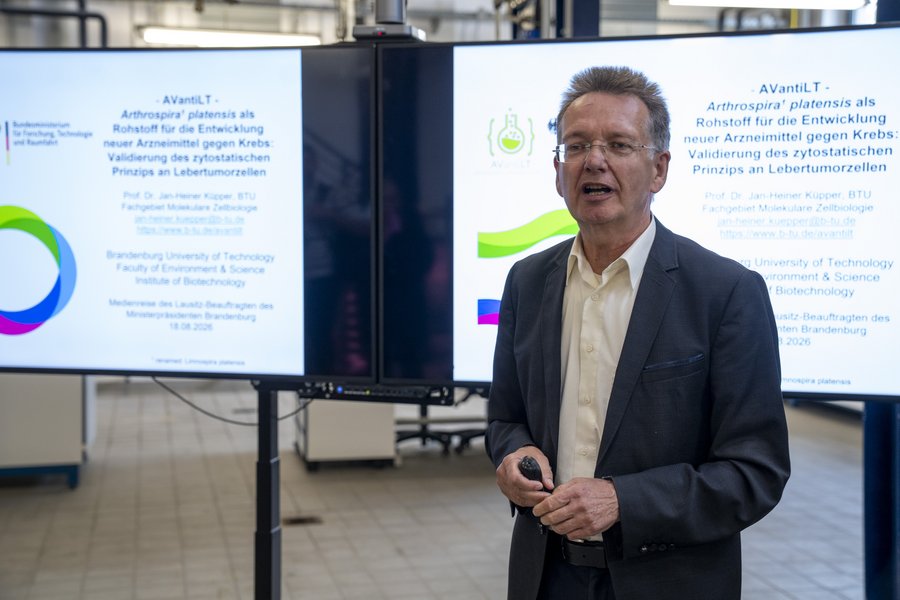
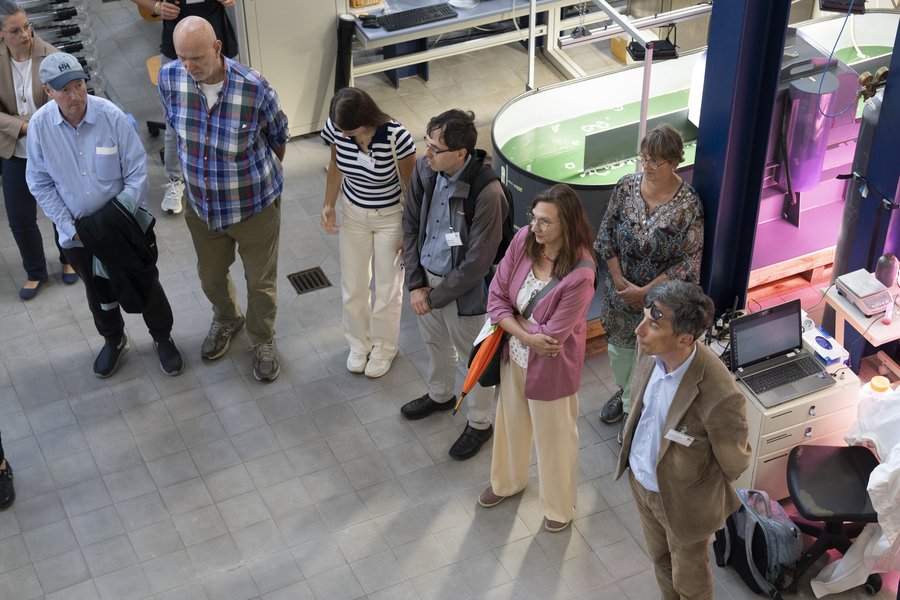
On the Senftenberg campus, researchers from the BTU have now presented their AVantiLT project – with an objective one does not hear about every day: can a microalga combat liver cancer? Prof. Dr. rer. nat. Peer Schmidt (BTU Vice-President for Academic Affairs), Dr. rer. pol. Johannes Staemmler (BTU Department of Profile Development and Excellence) and Prof. Dr. rer. nat. Jan-Heiner Küpper, Dr Sarah Kammerer and Dr Steffen Braune (BTU chair of Molecular Cell Biology) welcomed the guests.
The focus is on Arthrospira platensis, better known as ‘spirulina’ – strictly speaking a cyanobacterium, but colloquially usually referred to as a microalga. Initial evidence suggests that compounds in the microalgae can inhibit the growth of various tumour cells whilst sparing healthy tissue. However, this phenomenon has not yet been systematically investigated.
This is precisely where the research group led by Prof. Jan-Heiner Küpper, Head of the Molecular Cell Biology chair, comes in. As liver cancer is on the rise worldwide and is one of the types of cancer with a particularly poor prognosis, the team is focusing on liver tumour cells. The central hypothesis is that compounds in spirulina could inhibit the growth of liver tumour cells without damaging healthy liver cells.
Using methods from natural product chemistry, the researchers aim to identify the pharmacologically active substances in spirulina extracts. Systems biology and bioinformatics approaches will then be used to clarify the mechanism by which these substances act. If this can be demonstrated, AVantiLT would be the first systematic study of its kind – with the potential to provide a completely new avenue for cancer treatment.
From microalgae to active ingredient and local
value creation The project, scheduled to run from 2022 to 2027, is funded by the Federal Ministry for Research, Technology and Space (BMFTR) with around 1.85 million euros. But AVantiLT is more than just basic research: the results are to be commercialised via the newly founded Senftenberg-based biotech start-up Carbon Biotech GmbH – possibly in cooperation with pharmaceutical companies.
Highly skilled jobs will be created in Lusatia even whilst the project is still ongoing. In the long term, it is even conceivable that a dedicated value chain for the local production of high-purity spirulina raw materials could be established – with applications extending far beyond new cancer drugs: from herbal medicines and food supplements to vegan foods and animal feed.
The AVantiLT project is also an outstanding example of how students particularly those in the bachelor’s program in Biotechnology and the master’s program in Biotechnology are involved in real research. To date, 14 academic theses have been completed or are in progress as part of this project, including three doctoral dissertations.
A key component of the Lausitz
AVantiLT health region thus forms part of a wider narrative: the Lausitz is increasingly positioning itself as a model region for the health and medicine of the future. Between the development of university medicine at MUL – Carl Thiem, AI-supported diagnostics by start-ups such as IQONIC.AI, and basic research such as that carried out at BTU, an ecosystem is emerging that closely intertwines science, spin-offs and regional value creation.
For the Lausitz, this is further evidence that the region is transforming from an energy hub into a knowledge hub, and that this transformation is no longer taking place merely on paper, but literally in the laboratory.
Contact
Kommunikation und Marketing
T +49 (0) 3573 85-283
ralf-peter.witzmann(at)b-tu.de