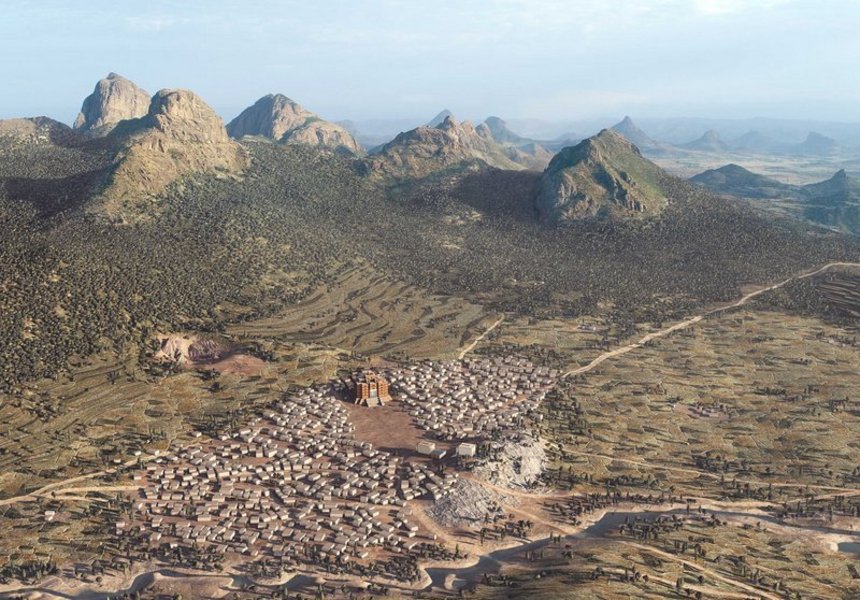
BTU structural engineer provides new insights into an ancient palace in Ethiopia
In July 2026, the article “Numerical Investigations of Timber-Reinforced Wall Constructions with Uncertain Material Parameters for the Ancient Palace Grat Be’al Gibri in Yeha, Ethiopia” was published in the specialist journal *Heritage* (MDPI).
The study, conducted by Prof. Martin Drieschner, Dr.-Ing. (Eng.), from the chair of Structural Analysis and Dynamics at the Brandenburg University of Technology Cottbus-Senftenberg (BTU), and Dipl.-Ing. Mike Schnelle, from the Sana’a branch of the German Archaeological Institute (DAI), centres on the Grat Be’al Gibri Palace in Yeha, situated in the Ethiopian-Eritrean highlands. With a floor area of approximately 60 by 60 metres, it is considered the largest known palace complex of its time in South Arabia and East Africa. Dating from around 800 BC, it was destroyed by fire as early as antiquity. Today, only parts of the ground floor and the podium remain.
A combination of timber and masonry as a construction principle
What makes the building historically significant is its wall system: timber beams were systematically inserted into the mortared rubble masonry and laid exclusively horizontally, alternating between the longitudinal and transverse directions of the wall. This and similar construction methods, known as ‘timber-laced masonry’, were widespread in South Arabia and north-eastern Africa during the first millennium BC for multi-storey buildings. They are reminiscent of modern hybrid structures incorporating timber, such as those currently being used or planned in sustainable high-rise construction in cities such as Sydney, Hamburg or Berlin.
3D model taking material uncertainty into account
Until now, claims regarding the height of such structures have been based primarily on historical sources and pictorial representations: Arab historians report palaces with up to 20 storeys, whilst South Arabian rock and wall paintings depict tower-like, multi-storey buildings. However, there had been no engineering analysis of these accounts. This is precisely where the collaboration between the DAI and the BTU comes in.
For the study, the researchers created a virtual 3D model of two representative wall sections of the palace – a wall corner and a doorway – and analysed their load-bearing capacity using the finite element method (FEM). As many of the material properties of the ancient building materials are not precisely known, a method was employed to account for polymorphic uncertainty in the material parameters. The self-developed software tool PolyUQ was used for the calculations.
At least 19 storeys are structurally feasible
The result: variations in the properties of the timber have only a minor influence on the load-bearing capacity of the walls. The wall system examined proved to be robust. According to initial calculations, a structure with at least 19 storeys would have been structurally feasible. This would have meant that the Palace of Yeha could well have reached skyscraper proportions. Based on the remaining structural reserves, the authors also conclude that an extraordinary event – presumably the great fire recorded in historical accounts – must have been responsible for the building’s collapse.
Building research meets engineering
“This project is a prime example of the insights that interdisciplinary collaboration can yield,” says Associate Professor Dr.-Ing. Martin Drieschner, chair of Structural Analysis and Dynamics at the BTU. “For us as structural engineers, it is particularly exciting that our methods from modern civil engineering – such as the application of the FEM and the modelling of fuzzy material parameters – can be applied directly to a 2,800-year-old structure. This underlines just how powerful numerical simulation is, even beyond traditional civil engineering applications.”
The collaboration between the Structural Analysis and Dynamics chair and the DAI’s Sana’a branch is part of a long-term Ethiopian-German research project, DFG-funded, to investigate the Yeha archaeological site in northern Ethiopia.
Publication: Drieschner, M.; Schnelle, M. (2026): Numerical Investigations of Timber-Reinforced Wall Constructions with Uncertain Material Parameters for the Ancient Palace Grat Be’al Gibri in Yeha, Ethiopia. Heritage, 9(7), 270.
Subject specialist
Press contact