
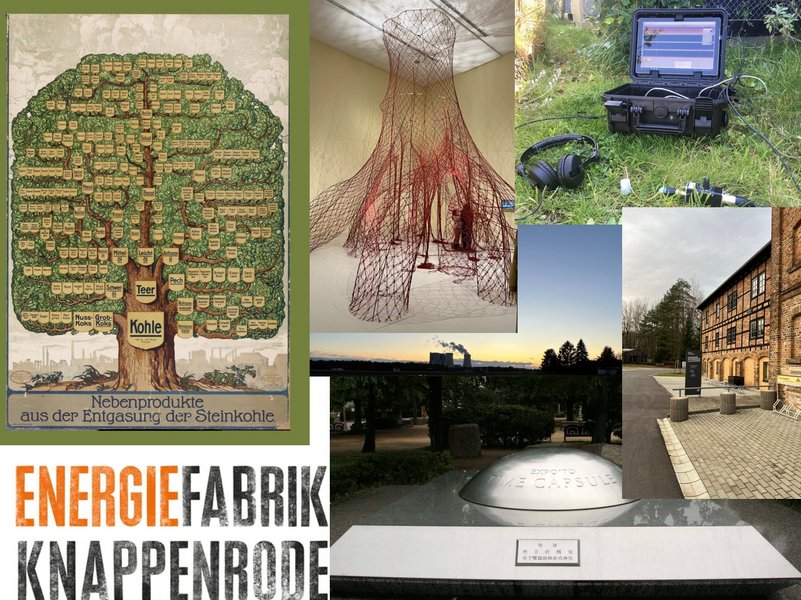
Study Project "Carbon 3EX": Excavation, Extraction, Exploitation Timescapes and Geo-Logics of Lusatia
Coal is the material that has predominantly shaped Lusatia, including Cottbus, for around 100 years. Particularly the industrial EXploitation of the Lausitz brown coal has structured the social, economic and political life in the region. The EXcavation activities have shaped the whole landscape, erased smaller villages, and it has strongly influenced the Sorbian heritage and the relationship between Sorbs, Germans and migrants who were needed as workers. The still ongoing EXtraction on several levels are the main focus of this study project with a special emphasis on the material extraction and extractivism theories. The study project Carbon 3EX took place in the Summer Semester 2024.
Examining the Material History
What we call coal is the remnant of a breathtakingly vibrant and diverse ecosystem that existed in Lusatia about 12-15 million years ago. The earth's climate was significantly wetter and warmer than it is today, and Central Europe was in a subtropical zone. Where there are pines and birches today, there were evergreen deciduous forests with laurels, magnolias, figs and palms. The evergreen forests were flooded, their trees and shrubs food for microorganisms, covered with sand, and intensive metabolic processes led to the formation of bogs and peat and, over millions of years, to sediments with a high proportion of organic matter, which were compacted and shifted by geological processes such as the ice ages. What we see today, when we visit lignite mines such as the one in Welzow, are plants millions of years old, that are still identifiable: plant fibers, some of which are several meters long, and the material extracted from the exposed layers with its criss-crossing fibrous structures is more reminiscent of trees felled by wind than of rock. It takes a great deal of technical effort and energy to transform this material into industrial coal. And while other fossil wood is exhibited in natural history museums as "petrified wood" and reverently admired for its testimony to millions of years of earth history of the Miocene, wood fibers in Welzow South are nothing but an obstacle in the open-cast mining process.
Timescapes of wood
In this project, we traced the timescapes of the genesis of the coal and the path of its transformation into the industrial product “energy”. We took a closer look at the performative strategies of museums, how they thematize geological timescapes and which objects are exhibited and how. What characteristics and values are invoked with an exhibit of "old wood" when it is thematized as a witness to long past eras, as a socio-economic product, as a source of energy, or as a driver of climate change and CO2 producer? When did the phenomenon called extractivism started and how is it linked to the development of theories in the field of political ecology that deal with the concept of ecotechnology as a counter-concept? And what does it mean to the soils when they are so heavily worked, when suddenly the bottom is on top and the soils quite literally lose their cohesion. How does the new layering of the landscape affect humans and animals, especially the animals that live in the soil, but also our understanding of the cultural landscape?
The cultural technicity of coal
Another aspect of coal is that it has been used by people for thousands of years and is therefore also a testimony to the cultural development of different cultures. Archaeological finds bear witness to this and can provide information about earlier human-environment relationships, particularly through technical reconstructions of craft techniques and structures. Increasingly, questions about more sustainable ways of life are also being asked in this context, for example old agricultural varieties are being cultivated again, energy balances are being drawn up and earlier building techniques are being investigated. In this context, too, coal is being reconstructed in a certain way, which we looked at in more detail. In the age of the Anthropocene this research gains more and more importance when it is asked how the carbon cycle has changed and to what extent human activities have influenced it.