
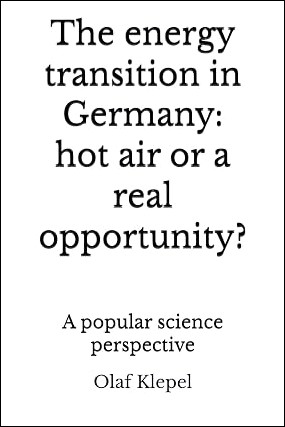
The energy transition in Germany: hot air or a real opportunity?
Olaf Klepel, Independently published, 2026, 65 pages, ISBN 979-8182193313
Germany has set itself the goal of reducing CO2 emissions to zero by 2045 and switching its energy supply to renewable sources, primarily solar and wind power. For this reason, all coal-fired power stations are to be closed by 2038. Furthermore, following a logic that is difficult to comprehend, the phase-out of nuclear energy was completed as early as 2023, even though this form of energy generation is largely CO2-free.
It is therefore hardly surprising that the implementation of the “German Energy Transition” is being discussed in Germany with a great deal of emotion and not always sufficient expertise. Supporters cite the implementation of the Intergovernmental Panel on Climate Change’s targets, which amount to a complete cessation of CO2 emissions by 2045. Critics counter that full implementation of this target would lead to the extensive deindustrialisation of Germany and thus its economic decline. The supporters, in turn, counter that saving the climate is the top priority and that Germany should take on a role as a global role model. The critics, on the other hand, claim that the world will judge Germany’s initiatives not so much on moral grounds but purely in practical terms: do they increase prosperity, or do they tend to have the opposite effect? Well-meaning advice from know-it-alls is not welcome.
Against this backdrop, I have subjected the plans for the energy transition to a stress test and investigated whether a stable energy supply can be guaranteed even during prolonged periods without sunshine or wind. Various scenarios have been run through, from which everyone can then draw their own conclusions.