Art that doesn’t want to be smooth
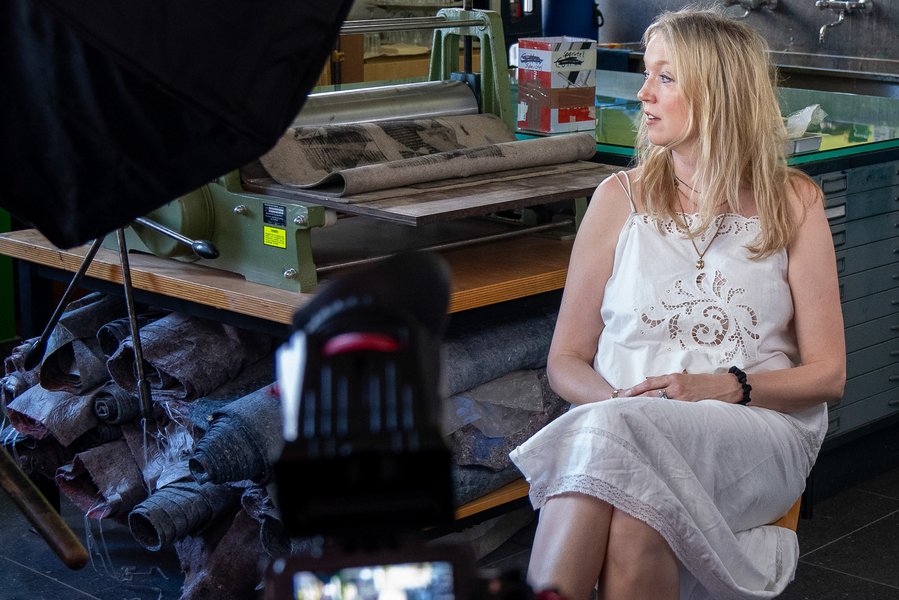
Since October 2023, Verena Issel has been Professor of Fine Art at the Brandenburg University of Technology Cottbus-Senftenberg (BTU). What she brings to the role is not textbook theory. It is an artistic practice that has developed over twenty years and is internationally acclaimed.
Art and Latin – two worlds, one mind
Issel, born in 1982, did something rather unusual: she studied two very different subjects in parallel. On the one hand, fine art, specialising in spatial installation and sculpture, at the University of Fine Arts in Hamburg. This was complemented by study visits to China and Portugal. On the other hand, she studied classical philology – that is, Latin and Ancient Greek – at the University of Hamburg.
In this interview, she explains how well these two worlds complemented each other: antiquity provided her with images and ideas for her art. Conversely, her knowledge of art helped her to gain a new understanding of antiquity. Her interest in ancient civilisations has remained to this day. She believes that we can learn a great deal about our own times from them.
This desire to bring two contrasting elements together runs through her entire body of work.
Drainpipes, pipe cleaners and a felt temple
Issel works with spatial installations, sculptures, films, drawings, collages and wall objects. Her use of mixed media is characteristic of her work: alongside traditional oil painting, her pieces feature everyday objects – drainpipes, pipe cleaners, bricks. At first glance, her installations often seem humorous or strange. But on closer inspection, they frequently address serious social issues.
A good example is her series “Klapp Klapp”. It was exhibited at the Kunstverein Springhornhof in 2021, and later at the Kunstpalais Erlangen. The series was created during the pandemic, initially just as a small private exercise. Over time, it developed into something more: the colourful motifs – lemons, high heels, earplugs, pipe cleaners – made their way from the canvas onto walls and the floor. Some objects suddenly emerge from the picture in three dimensions, whilst others remain flat. And right in the middle: a tongue-in-cheek “Schnuckentempel” – a nod to her love of antiquity.
In 2022, the Kunsthalle Mannheim presented her work “Backlash” in a solo exhibition. In the same year, the Lothar Fischer Museum also dedicated a solo show to her – in recognition of the Lothar Fischer Prize, which she had won in 2021.
An artist who has seen much of the world
What is particularly striking about Issel’s career is that she has been artistically active in an unusually large number of places. Through so-called artist-in-residence programmes – which are working stays for artists – she has spent time in Russia, Taiwan, South Korea, Japan, Iran, China, Lithuania and even Papua New Guinea, amongst other places. Most recently, she has spent time in Mexico and Zambia. In 2025, she even visited the Arctic, on Spitsbergen.
Solo exhibitions of her work have been held at venues including the Kunsthalle Mannheim, the Bundeskunsthalle in Bonn, the Volksbühne Berlin and the Westfälischer Kunstverein in Münster. She is also in high demand for group exhibitions – for example, at the 2023 Biennale in Montevideo, Uruguay.
Added to this are tangible successes in public spaces: in 2025, she won competitions for artworks at the Friedrich-Rückert-Schule in Erlangen and at the Federal Police Academy in Lübeck. In 2022, it was a nursery school in Munich. Her art is therefore not only on display in museums, but also in schools and public institutions – right at the heart of everyday life.
What this means for the BTU
When Verena Issel talks about students being allowed to think differently and everyone having the same opportunities, it is not just an empty phrase. It is exactly what she herself has been practising for twenty years: studying between Hamburg, China and Portugal. Switching between sculpture and language. Working between a museum and a police academy – without allowing herself to be pigeonholed.
That is precisely what makes her such a powerful role model. Not because she talks about equality, but because her work shows what that can look like: a woman who is taken just as seriously for her work with drainpipes as she is for her work with ancient temples, whose pieces hang in art galleries just as they do on school walls. And who is now passing on to young people at the BTU exactly what she herself has never given up: the courage not to sit on the fence, but to build something of her own from both worlds.
Contact
Press contact