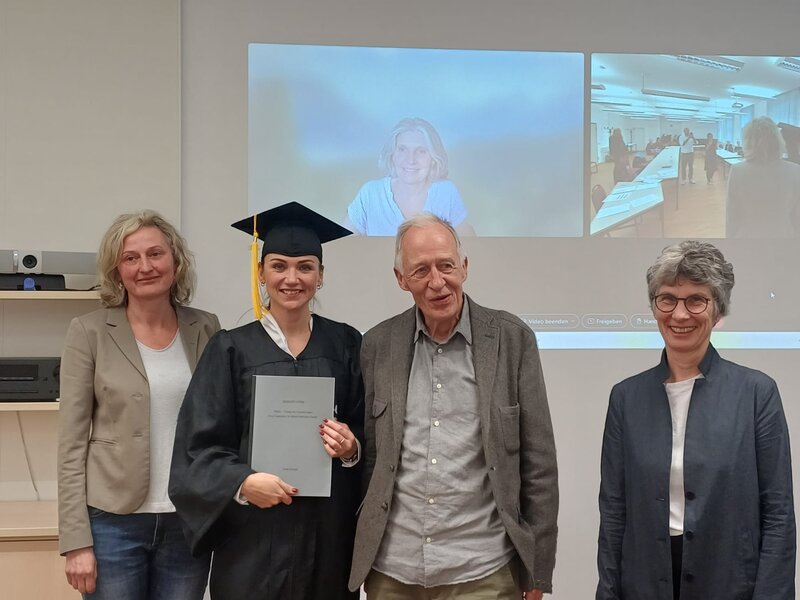
Congratulations on your PhD
In her doctoral thesis, Enikö Schradi (clinical social worker) examines ‘trialogue’ as an innovative form of support in the context of eating disorders. The term trialogue refers to a structured, non-therapeutic exchange on an equal footing between people with experience of eating disorders, their family members or caregivers, and specialist staff (e.g. doctors, nurses, therapists). This method has so far been established primarily in the treatment of psychosis and borderline personality disorder and has been positively evaluated by, amongst others, the Landshut research group. However, until now, no specific concept for a trialogue in the context of eating disorders had existed.
The thesis is based on a comprehensive review of the international research literature and subject-specific sources. Over 400 academic papers on eating disorders, the trialogue and its implementation in various contexts were taken into account. In the theoretical section, Enikö Schradi analyses in detail the psychosocial situation of those affected and their families, demonstrating the high levels of stress and stigmatisation experienced by both groups, as well as their need for support. A further chapter examines the specific challenges faced by professionals when working with eating disorders. Methodologically, a three-stage post-follow-up mixed-methods design was employed, combining qualitative and quantitative data and thus providing a nuanced picture of the feasibility of the trialogue in the context of eating disorders and the subjectively experienced benefits for participants.
The results show that the trialogue is rated very highly by all participating groups as well as by the specialist institutions. Its implementation, the framework conditions and the interactive exchange are perceived as successful. The concept, previously developed as part of the TRES project at the IKON Research Institute of Landshut University of Applied Sciences, has been confirmed as practicable. Participants found the trialogue helpful not only immediately after the session, but also six months later during the follow-up. They cited a deeper mutual understanding and a broadening of their perspective on eating disorders as key benefits. Through the exchange of experiences and knowledge in the trialogue, processes of reflection and learning are triggered on all sides, and a more constructive way of interacting with one another in family and professional contexts is fostered. Furthermore, those affected and their relatives report emotional relief, increased self-efficacy and empowerment, as they are able to step out of the role of those seeking help. The follow-up surveys suggest that insights gained from the trialogue can be transferred into everyday family and professional life. This is confirmed by all participating groups; the specialist organisations also draw a positive conclusion.
The doctoral thesis thus significantly expands the hitherto limited body of research on trialogue – which has been specifically lacking in the context of eating disorders – by providing key insights into important framework conditions and factors for success, as well as the subjectively experienced benefits that both participants and specialist institutions can derive from the trialogue. The concept has now been published by BELTZ as the ‘Practical Handbook on Trialogue for Eating Disorders’, which underlines its relevance for practice and ensures its transfer into practice. Trialogue for eating disorders is now permanently embedded in the services offered by all partner organisations from the TRES project. Furthermore, since the project’s conclusion, further organisations have joined, meaning that trialogue for eating disorders is spreading throughout Germany.
Doctoral Examination Board
Examiner: Prof. Dr. Alexandra Retkowski (BTU Cottbus – Senftenberg)
Examiner: Prof. Dr. Eva Wunderer (Landshut University of Applied Sciences)
Examiner: Prof. Dr. Werner Thole (TU Dortmund)
Chair: Prof. Dr. Heidrun Herzberg (BTU Cottbus – Senftenberg)
We wish Enikö Schradi all the best in her future academic and personal endeavours.
Completed PhDs / Publications from Faculty 4
Kontakt
Soziale Dienstleistungen für strukturschwache Regionen
T +49 (0) 355 5818-751
alexandra.retkowski(at)b-tu.de