Threads that connect: How embroidery is helping Ukrainian women in Berlin to weave a new home for themselves
Up to 30 people across eight workshops, four master embroiderers from Ukraine, a documentary film, a charity food sale and, finally, an exhibition showcasing what can be created when people embroider together. The project, run by the chair of Interculturalism at the Brandenburg University of Technology Cottbus-Senftenberg (BTU) and entitled “Connecting Threads – Building Community Through Vyshyvanka”, is an attempt to weave scattered life stories back into a fabric.
A garment as a map of identity
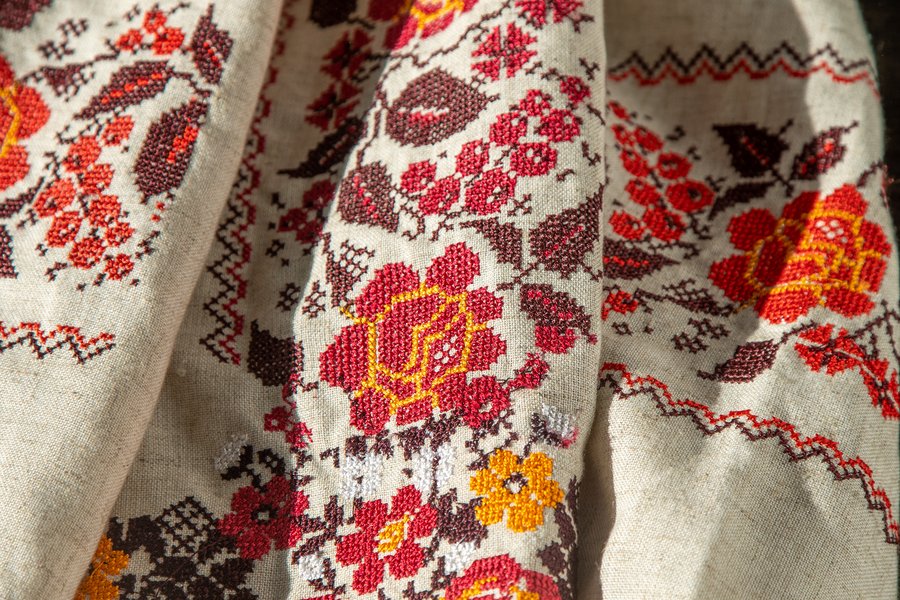
The vyshyvanka – the traditional Ukrainian embroidered shirt – is far more than just folklore in Ukraine. Every region, and in some cases every village, has its own patterns, colours and embroidery techniques. Anyone who can read the symbols can tell where someone comes from. For people who have been displaced by the war from precisely these regions, the garment takes on a different meaning: it becomes a wearable testament to the fact that their homeland has not been lost, but merely shifted.
This is precisely where the project comes in, initiated by Dr Estibaliz Sienra Iracheta, a cultural heritage researcher at the BTU. Since 2024, she has been supporting the first groups through the pilot project ‘Embroidering Ukraine in Berlin’. ‘Connecting Threads’ is the logical next step: scientifically grounded, artistically open-minded and socially committed.
Between the eye of the needle and academia
What makes the project special is its dual focus. On the one hand, there is the artistic practice: Under the guidance of master embroiderers such as Natalka Tyutyunnik and Tetiana Sukhodolskaya, participants learn regional stitches, motifs and patterns – craft knowledge that has been passed down through generations orally and by demonstration, and which now risks disappearing as a result of flight and displacement.
On the other hand, there is ethnographic research. Interviews, field notes, audiovisual documentation – all of this feeds into an academic analysis of how cultural practice can strengthen collective agency and resilience in situations of displacement. The researchers explicitly refer to an “ethics of care”: before anything is documented or published, every piece of sensitive information must be approved on a case-by-case basis. Anyone speaking about war, flight, separation or depression decides for themselves what of it is made public.
The launch: film, discussion, dinner
On Thursday, 3 September 2026, the Spore Initiative in Berlin will open its doors for the launch event. The documentary “Heritage of the Nation” (Спадок нації) will be screened, followed by a discussion with Lesia Voroniuk, founder of World Vyshyvanka Day, on the significance of embroidery for Ukrainian identity. The evening will be accompanied by a solidarity food stall run by the Rondell Ukrainische Küchen & Kultur Berlin collective – culture that goes through the stomach, serving as a low-threshold introduction for anyone still hesitant to join the group.
Afterwards, the real work begins: over the course of seven further Thursdays, every two weeks until 10 December, there will be embroidery, storytelling and experimentation. Four of the sessions will be dedicated to individual master embroiderers, each of whom will present the techniques of their home region. The project culminates in a pop-up exhibition – curated not by outsiders, but jointly with the participants themselves.
Figures that set the scene
The stark statistics behind this: according to the Federal Office for Migration and Refugees, more than 75,800 Ukrainian refugees have arrived in Berlin alone since 2022 – predominantly women, children and young people. Many of them are living with temporary protection status, in a limbo between arrival and the desire to return. The project is deliberately open to everyone, regardless of residence status, age, gender or disability. The Spore Initiative’s premises are accessible; all meetings are interpreted into Ukrainian and English; children are welcome when accompanied – though there is no formal childcare provided, nor is there any clinical psychological support. The project is explicitly not a therapy programme, even though it may have a therapeutic effect.
More than just a course
What begins as a craft workshop is conceived as an empowerment project. The organisers speak of ‘visibilisation’ – the process of making visible a community that is otherwise often perceived merely as a statistic or a news item. Those who decide for themselves which pattern to embroider and which story to tell alongside it regain a measure of authorship over their own narrative – an alternative to the external control that fleeing and arriving in a new country often entail.
In the long term, the project is intended to have an impact beyond the exhibition: through a digital multimedia archive, academic publications and the vision of rolling out the model to other cities and countries where Ukrainians now live. Some participants might even be able to earn a small income later on from the techniques they have learnt – for example, by selling their own embroidery.
Threads as Resistance
In the end, what remains is an image that gives the project its name: threads, which appear vulnerable when viewed individually, come together in a stitch to form a pattern that holds. For people whose threads of life have been brutally severed by the war, continuing to work stitch by stitch is perhaps the quietest, yet most tenacious, form of resistance: weaving on a story that should not end simply because it has been interrupted.
Registration for the workshops is available at connecting-threads(at)b-tu.de. Participation is free of charge.
Contact