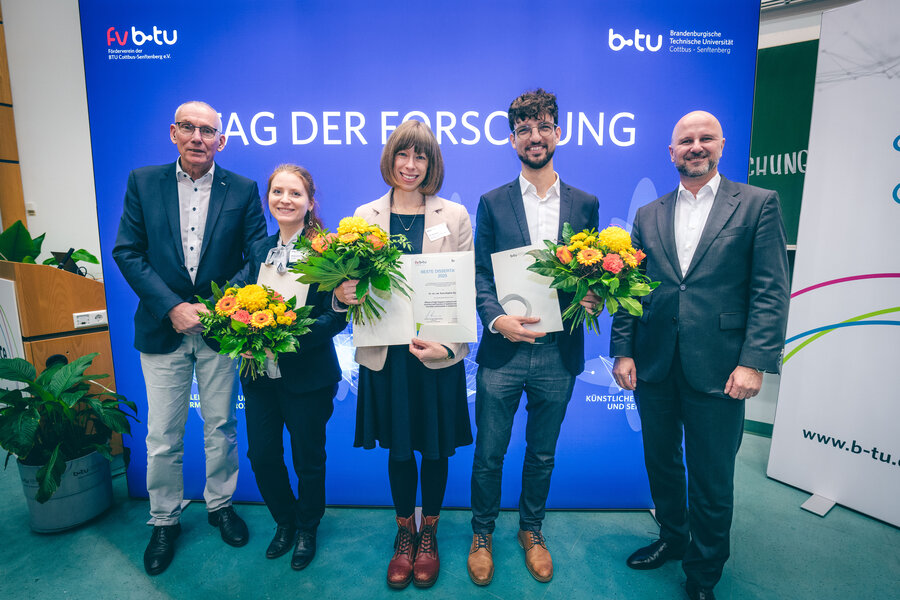
Excellent research that makes a difference in the region
Under the motto “Science meets Transfer: Socially minded, socially impactful!”, more than 120 researchers and representatives from business and society gathered on the Cottbus-Sachsendorf campus on Wednesday, 11 November 2026.
The focus was on outstanding research achievements, innovative transfer projects and the question of how scientific findings find their way into practice. The guests were welcomed by BTU President Prof. Dr Gesine Grande and Prof. Dr Heidrun Herzberg, Vice-Dean for Research at Faculty 4 of Human Sciences.
Research and knowledge transfer as drivers of change in Lusatia
The BTU sees itself as an active contributor to structural change in Lusatia. The fact that the 3rd Research Day and the 11th Transfer Day were held jointly for the first time underlines the university’s commitment to combining scientific excellence with regional responsibility.
“We are continuing to expand our research hub: through an initiative to raise the profile of our research, new major structural change projects and the Lausitz Science Park. Today, our researchers are showcasing the breadth of their work – from health and Social Work to sustainable energy systems. Transfer Day highlights how scientific findings give rise to concrete solutions that benefit people and businesses in the region. Together, these two events demonstrate how important the interplay between research and transfer is for the development of Lusatia. “The doors of the BTU are open when it comes to tackling technical, economic and social challenges together,” says Prof. Dr Uwe Riedel, Vice President for Research and Transfer at the BTU.
The event kicked off with a keynote address by Prof. Dr Raj Kollmorgen from Zittau/Görlitz University of Applied Sciences on societal transformation and social innovation. This was followed by a panel discussion in which representatives from academia, the healthcare sector, business and regional development – including Prof. Dr Alexandra Retkowski (BTU), Janine Schollbach (Wirtschaftsregion Lausitz GmbH), Prof. Dr Johannes Beller (Lausitz Medical University – Carl Thiem) and Sebastian Krüger (TELUX Weißwasser) – on the role of research and knowledge transfer in the structural transformation of the Lausitz region. The afternoon focused on practical examples: Dr Matthias Kirbach from the Brandenburg Economic Development Agency presented the Social Innovations Transfer Centre, whilst BTU researchers Alexander Elsner and Stefan Binder showcased a delivery robot for essential public services. Along the ‘Research and Transfer Trail’, researchers provided insights into their projects. During the ‘Poster Flash’, PhD students and postdocs each presented their projects in two minutes.
Outstanding Research and Transfer
The recognition of outstanding scientific achievements was another highlight of the day’s programme: alongside the BTU Transfer Prize, awards were presented for the best doctoral theses and outstanding publications by experienced researchers and early-career academics, whilst the three best contributions from the ‘Poster Flash’ were selected via a public vote.
BTU Transfer Prize 2026: Three projects with tangible benefits
A highlight of the day’s events was the presentation of the BTU Transfer Prize 2026. This year, it recognises excellent and particularly impactful transfer collaborations, achievements and projects in the category ‘Research and Development in Dialogue with Society’ and comes with a total prize fund of 14,000 euros. It is funded by the BTU, the Friends of BTU Cottbus-Senftenberg e. V. and the Lausitz Business Association – the Economic Initiative. Three projects from different fields of research presented their findings in short presentations and impressed the jury.
1st place (7,000 euros): Buildings – AI scanner captures building components in real time
As part of the collaborative project ‘Real-time Building Component Inventory’, Prof. Ilija Vukorep, Lukas Fritzsche and Rolf Starke from the Digital Design Methods chair, together with Dr Benjamin Felbrich from Tamarama Technologies UG and Udo Rettinghaus from Gebäudewirtschaft Cottbus GmbH (GWC), have developed a portable AI scanner. It recognises, counts and measures building components such as windows, doors and radiators directly during a building inspection – without the need for an existing building model. Its self-localisation has an average deviation of only around three centimetres, whilst lengths and areas are determined with a maximum deviation of around five per cent. The system was tested, amongst other places, in a residential building owned by GWC Gebäudewirtschaft Cottbus. It is intended to facilitate renovations and conversions, as well as to promote the reuse of building components.
2nd place (4,500 euros): Energy – planning electricity grids more efficiently
The Energy Economics chair, headed by Prof. Dr Felix Müsgens, has developed the DESOX planning tool in collaboration with the transmission system operator 50Hertz at the Energy Innovation Centre (EIZ). It combines the planning of electricity generation, battery storage, electrolysis and grid expansion into a single model. Compared with established models, it reduces computation time by up to 75 per cent. DESOX is already in use at 50Hertz and is set to be released as open-source software. The tool also enables a thorough analysis of suitable sites for power stations, storage facilities and electrolysers in the Lusatia region. The project team comprises Prof. Dr Felix Müsgens, Dr Christin Hoffmann and Dr Jakob Pohlisch (BTU) as well as Lene Grübler (50Hertz).
3rd place (2,500 euros): Nursing – Research Strengthens Training
The Neksa project, led by Prof. Dr Heidrun Herzberg, chair of the Department of Educational Sciences and Vocational Education in Health Professions, worked alongside the University of Technology in Dresden and the Association of Nursing Schools to support the implementation of the new nursing training programme in Brandenburg. Thirty of the state’s 31 nursing schools took part. This resulted in further training programmes, recommendations for action and a network for exchange amongst teaching staff. The project, which was funded by the State of Brandenburg in previous years, demonstrates how research can have a direct impact on professional practice and healthcare provision.
Poster Flash: Research in Two Minutes
During the ‘Poster Flash’, PhD students and postdocs from all disciplines at the BTU presented their projects in two minutes each – concisely, clearly and to the point. Following the presentations, the audience voted live. The three entries with the most votes were awarded prize money: 500 euros for first place to Maria Annegret Martin (chair of Educational Sciences for Social Work), 300 euros for second place to Sara Molaei (Technoscience Studies chair) and 200 euros for third place to Akant Sengül (Experimental Physics and functional Materials chair).
Best Paper Awards: Recognition for outstanding research
With the Best Paper Awards, the BTU honours outstanding academic publications by experienced researchers and early-career academics. The rankings were determined by the Committee for Research, Early-Career Academics and Technology Transfer. Both prizes are endowed with 2,500 euros each for the respective chair.
Best Paper Award “Senior Researchers”
First place was awarded to Prof. Dr Inga Anita Fischer from the chair of Experimental Physics and functional Materials. The award recognised her publication ‘Strong Photoluminescence Enhancement in All-Dielectric Ge Thin Film Metasurfaces for Integration on the Si Platform’.
View the publication (DOI: 10.1002/adom.71558)
Best Paper Award “Young Researchers”
First place went to Maksim Radionov from the Computational Materials Modeling chair. The award recognised his publication “Attosecond Momentum-Resolved Resonant Inelastic X-ray Scattering for Imaging Coupled Electron–Hole Dynamics”.
View the publication (DOI: 10.1021/acs.jpclett.6c00998)
Best PhD Thesis: Three outstanding research projects
The prize for the best doctoral thesis, awarded by the BTU Friends’ Association, went to three early-career researchers. All three theses were awarded the grade ‘summa cum laude’. The ranking was determined by the Committee for Research, Early-Career Researchers and Technology Transfer.
1st place (2,500 euros): Dr Anna Oprei, chair of Aquatic Ecology
Dr Anna Oprei investigated, through field studies – including on the River Spree – and laboratory experiments, how sediment movements in sandy watercourses influence microbial communities. Her findings show that sediment deposition shapes the diversity and metabolic activity of microorganisms. This helps to better assess the resilience of water bodies to stresses such as desiccation. The results of her work have been published in, amongst others, the renowned journal *Limnology and Oceanography*. She was supervised by Prof. Dr Dominik Martin-Creuzburg, with Prof. Dr Markus Weitere from the Helmholtz Centre for Environmental Research acting as an additional examiner. Oprei is now conducting research at the Leibniz Institute for Aquatic Ecology and Inland Fisheries in Berlin.
2nd place (2,000 euros): Rebecca Erika Schmitt, chair of Construction History
Rebecca Erika Schmitt investigated the curved vaults of 16 Baroque churches associated with the Dientzenhofer family of architects using laser scans and geometric comparisons. Her work demonstrates that the seemingly complex forms are based on simple circular arcs and could be constructed using circular template arcs and straight planks. In doing so, she refuted the widespread assumption of complicated intersections of solid figures. The examiners from ETH Zurich and LMU Munich attested that the work raises research to a new level. It was submitted by Prof. Dr.-Ing. David Wendland. A publication as a specialist textbook is in preparation.
3rd place (1,500 euros): Dr.-Ing. Marco Gambitta, Chair of Structural Mechanics and Vehicle Vibrational Technology
Dr.-Ing. Marco Gambitta developed a method to predict the effects of minute manufacturing deviations in aircraft engine compressor blades on their vibration behaviour. To achieve this, he combined optical scans of real blades with digital twins and AI methods. The method, developed as part of a BMWK-funded project with Rolls-Royce Germany, is now being used there in day-to-day operations. Gambitta has also received the Rolls-Royce Germany Innovation Awards twice. The work was submitted by Prof. Dr.-Ing. Bernd Beirow.
Excellent research as a driving force for the Lusatia region
With its joint Research Day and Transfer Day, the BTU underlines its role as a driving force for the scientific, economic and social development of the Lusatia region. The award-winning research projects and transfer initiatives demonstrate how scientific excellence has an impact beyond the university and makes concrete contributions to the region and its future. They also highlight the thematic breadth of the BTU’s research profile. Its four priority areas were reflected in the day’s programme – from the keynote speech on societal transformation, through DESOX and the AI scanner, to nursing training:
- Global Change and Transformation Processes
- Energy transition and decarbonisation
- Health and Life Sciences
- Artificial Intelligence and Sensor Technology
With this joint format, introduced for the first time, BTU Cottbus-Senftenberg showcased research and knowledge transfer in a single day and further strengthened dialogue with partners from industry and society.
Contact
Kristin Ebert
Communications and Marketing
T +49 (0) 355 69-2115
kristin.ebert(at)b-tu.de
Contact
Abteilung Forschung
T +49 (0) 355 69-5500
ines.brusch(at)b-tu.de