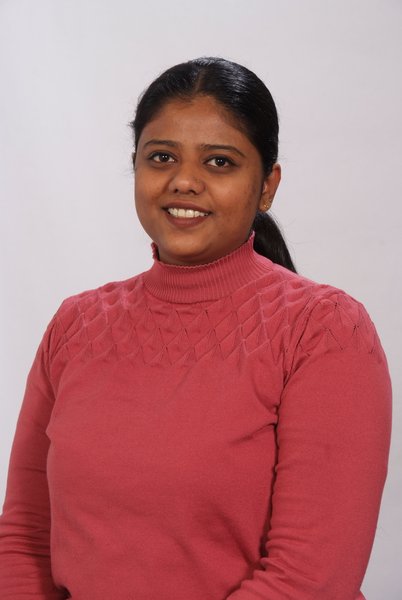
Interview with BTU Alumna Amalu Joseph (AI)
Amalu Joseph came from India to Cottbus studying Artificial Intelligence. She studied at Mary Matha Arts & Science College in India before and has several years work experience as a Software Engineer Web and Frontend Developer in India, Berlin and Dortmund. Now she finished her master‘s thesis about “Reliability study for transfer training in AI-based object detection tasks in images using YOLO“ in collaboration with Fraunhofer Institue for Photonic and Microsystems IPMS bridging academic research with practical industrial application.
Dear Amalu Joseph, how did you come to study for a master’s degree in AI at BTU, and what was your experience here?
My interest in Artificial Intelligence developed during my professional experience as a Software Engineer and Frontend Developer. While working on software solutions in India, I became increasingly interested in how AI can be applied to solve real-world problems and improve existing technologies. This motivated me to pursue a master’s degree specializing in AI. I chose Brandenburg University of Technology (BTU) because of its strong academic curriculum, research-oriented approach, and the opportunity to study in an international environment. My experience at BTU was very enriching, both academically and personally. The program provided a solid foundation in AI concepts while also encouraging practical implementation through projects and research collaborations. I also appreciated the supportive learning environment and the opportunity to interact with students and researchers from diverse backgrounds.
You had work experience beforehand and you were also working during your studies. How important do you value these practical experiences for your career?
I consider practical experience extremely valuable for my career development. My previous work experience helped me approach academic topics with a more practical and solution-oriented mindset and supported me in finding new job opportunities in Germany. At the same time, studying AI allowed me to deepen my theoretical understanding and apply it to advanced technological challenges. Working during my studies also helped me improve important professional skills such as time management, communication, teamwork, and adaptability. Combining industry experience with academic learning gave me a balanced perspective and prepared me well for real-world AI applications and interdisciplinary collaboration.
How did you find your jobs during your studies in Cottbus?
I mainly used LinkedIn and actively searched for opportunities related to software development and AI. I regularly followed company postings, connected with professionals in the industry, and applied to positions that matched my skills and interests. Staying proactive, continuously improving my technical skills, and maintaining a strong professional profile helped me secure job opportunities during my studies.
You wrote your master’s thesis in collaboration with Fraunhofer Institue for Photonic and Microsystems IPMS. How did that come about, and what advice would you give to students who are currently planning their own master’s thesis?
The collaboration with the Fraunhofer Institute for Photonic Microsystems IPMS came through my interest in applied AI research and industry-oriented projects. I was looking for a thesis topic that combined academic research with practical industrial relevance, particularly in the field of computer vision and AI-based object detection. My thesis focused on the “Reliability study for transfer training in AI-based object detection tasks in images using YOLO.” This experience allowed me to work on real-world challenges while gaining exposure to advanced research methodologies and industrial applications. For students planning their master’s thesis, my advice would be to choose a topic that genuinely interests them and aligns with their long-term career goals. It is also important to communicate regularly with supervisors, start early, and maintain a structured workflow throughout the research process. Collaborating with research institutes or industry partners can provide valuable practical exposure and open future career opportunities.
Now that you finished your master’s thesis, what is next for you? What do you have planned?
After completing my studies, I joined Evolvet GmbH in Cologne as an IT Consultant and Project Manager. In this role, I work on managing AI projects and supporting technology-driven business solutions. I look forward to further developing my expertise in AI, software technologies, and project management while contributing to innovative and impactful projects.
Kontakt