
Smart-City-Project "Gubenwabe"
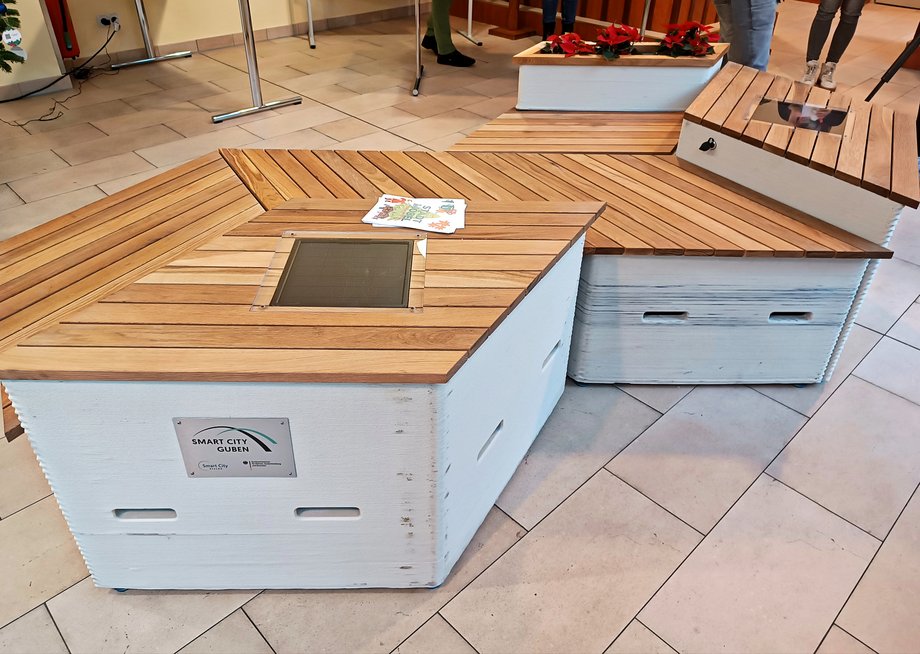
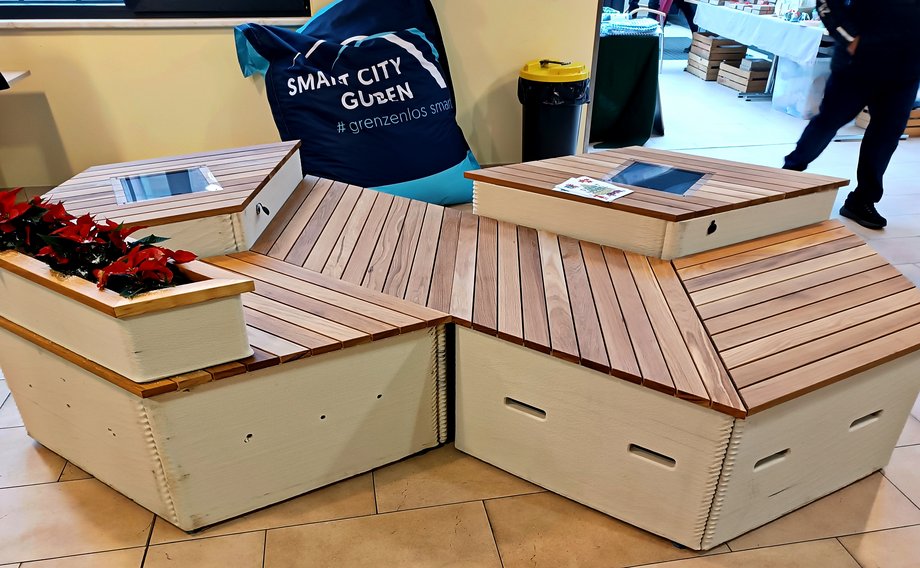
The Smart-City-Project presented its new street furniture for the first time at the Christmas market in Guben on December 13, 2025. The prototype presented was the modern "Gubenwabe" seating, which consists of three elements that can be combined to form a hexagon and has an integrated table surface. A solar panel enables mobile devices to be charged directly on site.
The street furniture subproject was launched in 2024 as a collaboration between school students from Guben, departments and staff at BTU Cottbus–Senftenberg, and Holzart GmbH Guben. According to the city of Guben on relevant social media channels, the Gubenwabe is thus a prime example of participation, sustainability, and innovation within the Smart-City-Project.
A combination of wood technology and 3D printing processes was used in its manufacture. The seating will be tested as new street furniture in public spaces in the future in order to gain experience in terms of functionality, acceptance, and technical equipment.
Smart Guben
Spaces and qualities for young people to spend time in Guben's urban space
Where do young people spend time in the city? What conditions, needs and conflicts exist in these places and how can new street furniture improve the quality of their stay? A collaboration between the Chair of Urban Design and Urban Studies at BTU Cottbus-Senftenberg, the Smart City project of the city of Guben and Pestalozzi-Gymnasium Guben will be taking place in summer 2024 to answer these questions. The focus is on the public spaces and meeting places used by young people in Guben as well as the requirements and wishes regarding the design of these spaces.
During the summer semester, an impromptu seminar is offered with Master's students of Urban and Regional Planning and Architecture. In May, an initial city tour and discussion on current urban development took place with Mayor Fred Mahro and employees of the city administration. This was followed in July by a joint working day with pupils from the geography course at Pestalozzi-Gymnasium. With the help of on-site inspections, interviews and the mapping method, the everyday spaces of young people in the city were examined in order to identify characteristics for the design of these spaces and to create the basis for designs for street furniture.