
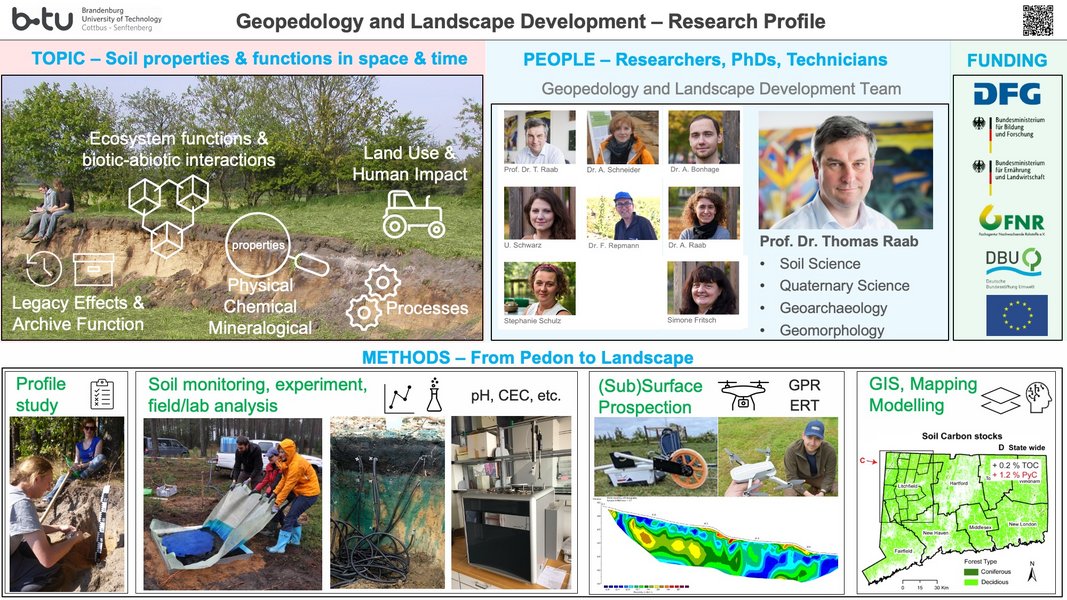
The study of the upper, extremely thin layer of the Earth's crust is of great socio-economic and ecological relevance: crucial processes occur here that control our natural ecosystems, shaped by humans and used diversely.
We follow a substrate-, relief-, and pedogenentic approach and investigate the close causal and functional relationship between the formation, distribution, and characteristics of surface forms and the soils therein.
The range of methods is relatively broad, and the application of specific analytical procedures depends on the specific research question. Fieldwork on geological and pedological outcrops is usually the foundation and an essential part. The typical procedure involves the analysis of
- Surface forms, either through available data (especially digital terrain models) or through or micro-drones based photogrammetry,
- Near-surface geological substrates, through outcrops and boreholes with sampling for laboratory analyses and/or indirect methods (especially Electrical Resistivity Tomography, Ground Penetrating Radar),
- Soils in the form of pedogenetic-substratgenetic classification with sampling for laboratory analyses.