Towards the Gothic: design and construction of vaults in the Middle Ages
In the large building sites in medieval Europe, the construction of vaulted ceilings shows a special dynamic: great spans were realized at breathtaking heights, new construction methods and construction details were developed. Particular challenges in design and construction were posed by the planning of complex shapes and the assessment of structural safety. Essential for the understanding of these constructions is the integration of building technology and design aspects, which are also related to the architectural ambition and the symbolic meaning of these prominent buildings. Written and pictorial sources on planning and building techniques exist only from later times - the most important source is therefore the buildings themselves. The research is based on the combination of building archaeology, practical experiments and reverse engineering.
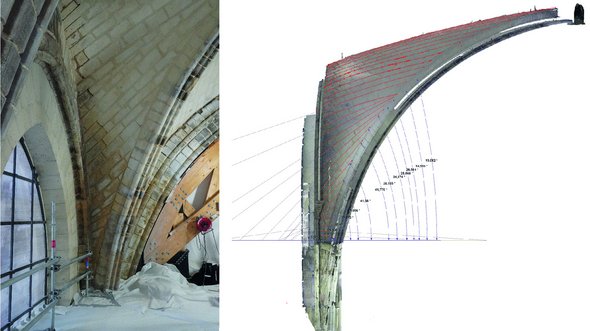
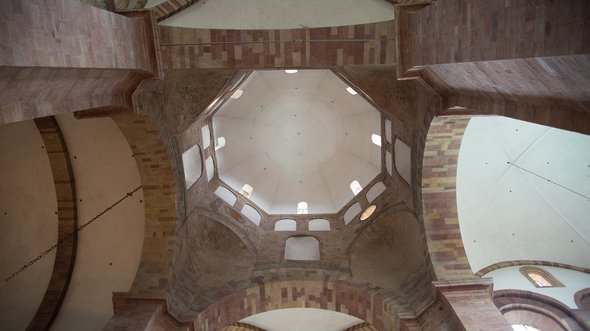
Current research focuses on the one hand on the 11th-century vaults in Speyer Cathedral – these are the first high, wide-spanned vaults over the nave of a large church, as well as the first rib vaults in medieval European architecture. On the other hand, the high vaults in the choir and nave of Notre-Dame in Paris (completed in 1177 and shortly after 1200 respectively), which we had the opportunity to study on site during the restoration after the fire, and of which we have been carrying out experimental analyses since 2019.
Publications:
Wendland, D., Gielen, M., & Korensky, V.: Towards the Gothic: Design and Construction of the 12th Century Vaults in Notre‐Dame in Paris, and Possible Origins. International Journal of Architectural Heritage, 19 (8), 2025, pp. 1231–1264. https://doi.org/10.1080/15583058.2024.2427661
Wendland, D.; Gielen, M.: The revolution in vault construction before the Gothic: Speyer Cathedral, some related examples, and the development of wide spanned vaults in the 11th and 12th centuries, In: S.M. Holzer, S. Langenberg, C. Knobling, O. Kasap (eds): Construction Matters. Proceedings of the 8th International Congress on Construction History. Zürich 2024, pp. 771-779. https://doi.org/10.3218/4166-8
Speyer Cathedral: scientific contribution to the conservation works
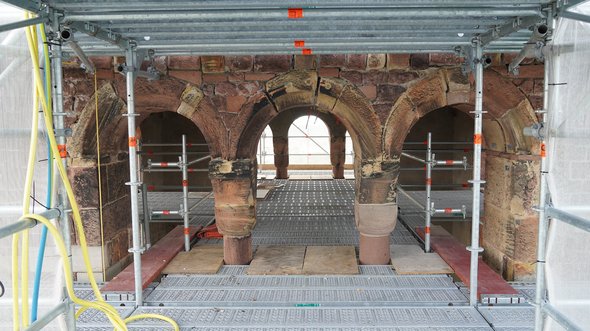
Since 2025, the Chair of Construction History is in charge of the scientific accompaniment of the ongoing conservation works at Speyer Cathedral. The extant medieval parts of the building, which date back to the 11th century, can be regarded as a landmark in the history of European architecture, particularly in the development of high and wide-spanned vaulted ceilings. Furthermore, the prominent extensions, alterations, new additions and refurbishments dating from the 15th century and the 18th to the 20th centuries are also of great interest from the perspective of architectural and structural history. Since 1981, Speyer Cathedral is listed as UNESCO World Heritage Site.
Focus is currently on the two towers in the eastern portion that are entirely preserved in their medieval fabric, while also featuring significant historical alteration phases and interventions for structural reinforcement from different periods.
In the framework of a data project under development at the Chair, a comprehensive digital survey of the cathedral is carried out.
Early shells in reinforced concrete
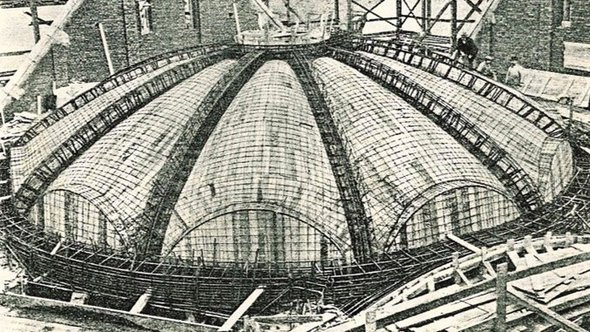
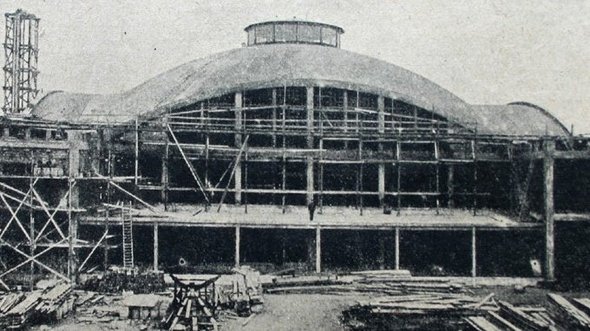
With the development of reinforced concrete in the late 19th century, this material was also frequently used for building shell structures. The special ability of reinforced concrete to absorb compressive and tensile forces opened up new possibilities for shell shapes - at the same time, the malleability of this material offers particular potential for constructions that are stable by virtue of their shape. Initially as simple single elements, these structural forms evolved into sophisticated and complex structures. Industrial development, theory of engineering, new construction tasks, and rapid, comprehensive knowledge transfer at the international level led to the development of new construction types of shells.
Publications:
Korensky, V.: Early reinforced concrete shells in Russia. In: Campbell, J. et al. (ed): Timber and Construction. Proceedings of the Ninth Conference of the Construction History Society, Cambridge: The Construction History Society 2022, pp. 361-371.
History of structural mechanics
Beyond the history of the theories to which we nowadays recur for describing the load-bearing behavior of structures, research addresses in general the ideas that were at the basis of the structural design in the past. Some historical theories are still valid and of practical relevance today. In any case they have significantly informed design and construction, and their understanding offers insight into the knowledge society in which a structure was created.
Publications:
Wendland, D.: Steinerne Ranken, wunderbare Maschinen: Entwurf und Planung spätgotischer Gewölbe und ihrer Einzelteile. Featuring Papers by M. J. Ventas Sierra, M. Aranda Alonso and A. Kobe. Petersberg: Michael Imhof, 2019
Wendland, D.: Brick Vaults by J.C. von Lassaulx and A. Antonelli: an Ancient Building Technique for the Industrial Age. In: Fuentes, P.; Wouters, I. (eds): Brick Vaults and Beyond the Transformation of a Historical Structural System from 1750 to 1970, Brussels: Vrije Universiteit Brussel, 2021. pp. 33-60. https://cris.vub.be/ws/portalfiles/portal/71201805/BELVAU._Fuentes_Wouters_2021._Brick_Vaults.pdf
Reverse Geometric Engineering of historical vaults
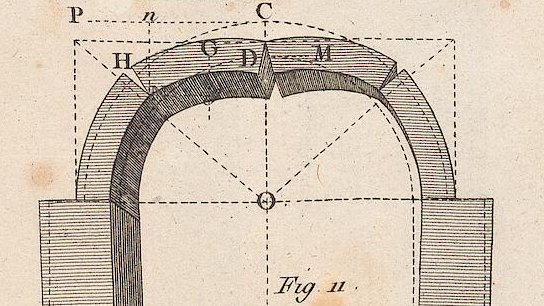
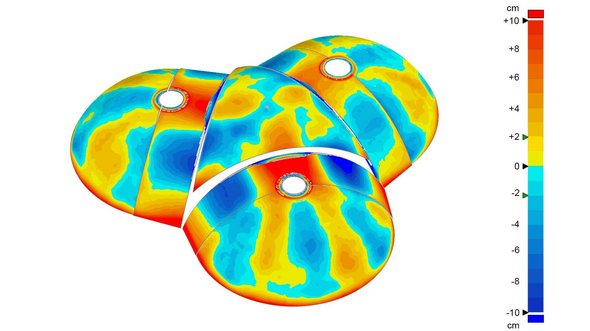
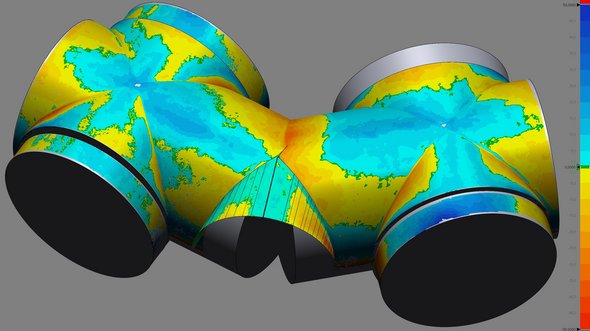
The curved surfaces of vaults due to their complex geometry place special demands on design. The procedures, terms and media used to define the shape and convey this information for execution must be understood in the context of the history of applied geometry. The research is based on three-dimensional measurement and geometric analysis of the buildings. Using digital tools from the world of industrial design, hypotheses about design and planning are developed, providing insight into the history of knowledge in the field of practical mathematics while opening new possibilities in the interpretation of creative processes.
Publications:
Wendland, D.: Lassaulx und der Gewölbebau mit selbsttragenden Mauerschichten. Neumittelalterliche Architektur um 1825-1848. Petersberg: Michael Imhof, 2008.
Wendland, D.: Arches and Spirals – The Geometrical Concept of the Curvilinear Rib Vault in the Albrechtsburg at Meissen and Some Considerations on the Construction of Late-Gothic Vaults with Double-Curved Ribs. In: Carvais, R. et al. (ed): Nuts & Bolts of Construction History: Culture, Technology and Society, pp. 351-357. Paris: Picard, 2012.
Wendland, D: Steinerne Ranken, wunderbare Maschinen: Entwurf und Planung spätgotischer Gewölbe und ihrer Einzelteile. Featuring Papers by M. J. Ventas Sierra, A. Kobe und M. Aranda Alonso. Petersberg: Michael Imhof, 2019.
Schmitt, R.E., Wendland, D.: The geometric design of the “Guarinesque” vaults in Banz and Vierzehnheiligen in relation to the treatises of stereotomy. In: Mascarenhas-Mateus, J. and Pires, A. P. (eds): History of Construction Cultures. Proceedings 7th International Congress on Construction History, Lissabon 2021, vol. 2 pp. 371-378. Leiden: Balkema, 2021.
Schmitt, R. E.: Geometric design and construction of a Late Baroque brick vault: Kilian Ignaz Dientzenhofer’s Benedictine church of the Holy Cross and St. Hedwig at Legnickie Pole. In: Campbell, J. et al. (ed.): Timber and Construction. Proceedings of the Ninth Conference of the Construction History Society, Cambridge: The Construction History Society, 2022, pp. 143-155. https://doi.org/10.26127/BTUOPEN-5905
Schmitt, R. E.: The geometric design of Christoph Dientzenhofer’s ‘radical’ vaults, In: Campbell, J. et al. (ed.): Studies in Construction History. Proceedings of the Tenth Annual Conference of the Construction History Society, Cambridge, 2023, pp. 143-155, https://doi.org/10.26127/BTUOpen-6408
Wendland, D.; Gielen, M.: Some considerations on the early development of cross vaults and rib vaults in medieval architecture, In: Campbell, J. et al. (ed.): Studies in Construction History. Proceedings of the Tenth Annual Conference of the Construction History Society, Cambridge, 2023, pp. 29-42.
Stereotomy
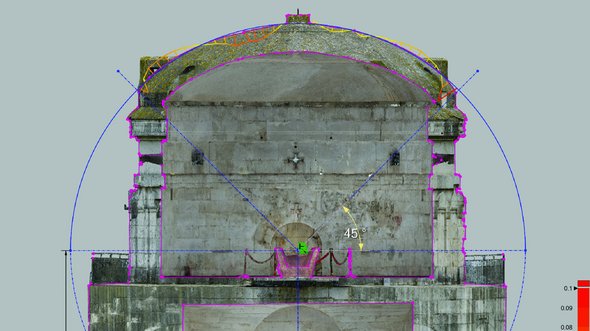
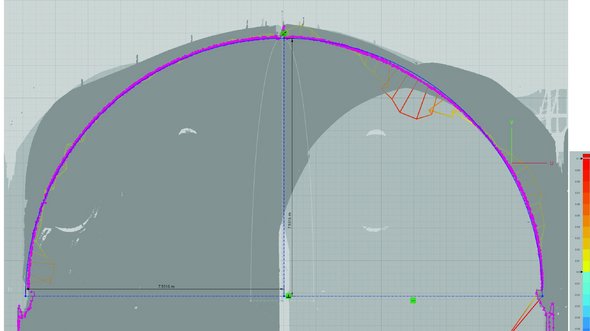
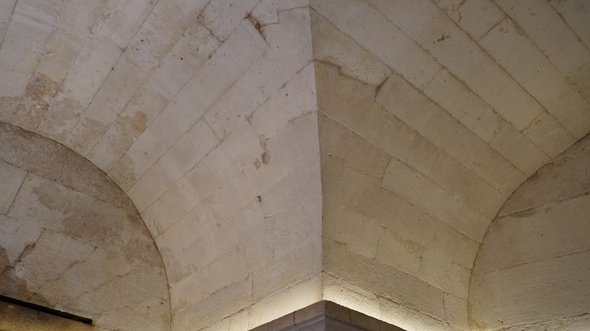
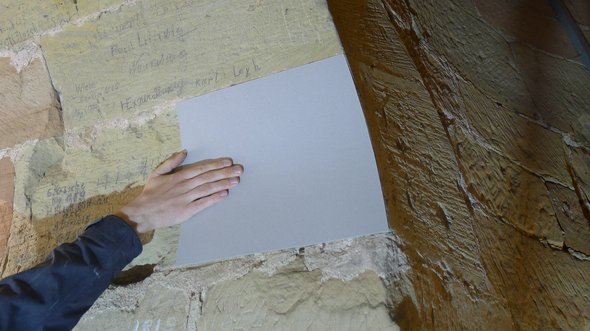
Research on the history of applied geometry in the planning of stone constructions with complex shape focuses on the "prehistory" of the procedures and practices described in early modern treatises: design principles that were cultivated and developed in the medieval building lodges, their origins and possible provenance. Historical knowledge is reconstructed through architectural archaeology, practical experiments, and interpretation of sources.
Publications:
Wendland, D.: Architekturzeichnung und ihre Rolle beim Entwurf komplexer Werksteinkonstruktionen in Spätmittelalter und Früher Neuzeit. Überlegungen am Beispiel der Katharinenkapelle im Straßburger Münster. Architectura 47 (1-2), 2019, pp. 1-23.
Wendland, D.: Steinerne Ranken, wunderbare Maschinen: Entwurf und Planung spätgotischer Gewölbe und ihrer Einzelteile. Featuring Papers by M. J. Ventas Sierra, A. Kobe und M. Aranda Alonso. Petersberg: Michael Imhof, 2019.
Bücherl, H.: Incomplete: The discontinued building project of a Greek temple of the Classical period. In: J. Mascarenhas-Mateus and A.P. Pires (eds): History of Construction Cultures. Proceedings 7th International Congress on Construction History, Lissabon 2021, Vol. 2, pp. 17-23. Leiden: Balkema, 2021.
Bücherl, H.: Die Treppenanlagen des Tempels A in Selinunt. In: A. Rickert and S. Schlosser (eds): Gestaltung, Funktion und Bedeutung antiker Treppenanlagen: Multiperspektivische Analyse einer transkulturellen Konstante, pp. 313-336. Münster: Zaphon, 2022.
Lengenfeld, J.; Wendland, D.: Die Planung der komplexen Werksteinkonstruktion im Bergfried der Schönburg – das Werk eines Naumburger Meisters. In: Rauhut, C. et al. (Ed.): Materialgerecht konstruiert?!? Tagungsband der Fünften Jahrestagung der Gesellschaft für Bautechnikgeschichte 2021, pp. 87-104. Petersberg: Imhof, 2023.
Windmills
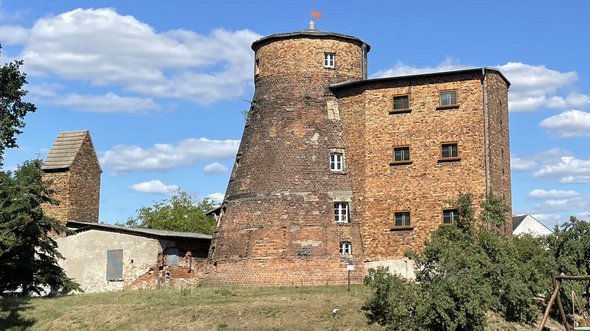
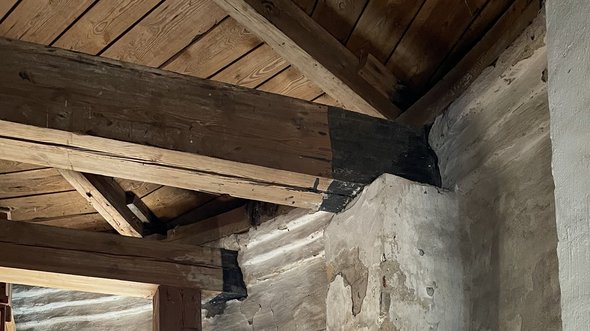
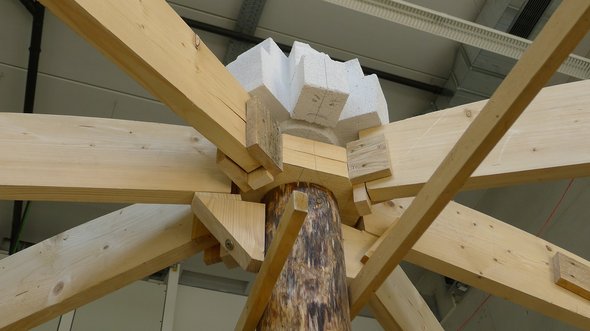
Technical monuments in the region - knowledge transfer in the industrial age. The so-called “Dutch windmills” were built as conical masonry structures made of brick with intermediate ceilings made of wood. The timber and masonry constructions, dynamically loaded by the mechanics of the grinding mill and the wind wheel, underwent many structural changes due to the development of the machinery and propulsion technologies. Documentation of the existing construction of the windmills provides the basis for developing concepts of safeguarding and conversion.