
Key Research Areas
Brief overview
The Chair’s key research areas focus on Joining and Welding Technology, as well as additive manufacturing. On the one hand, all relevant aspects along the process chain are covered, i.e. from filler materials through process control to material and component testing. On the other hand, this research is extended to the digital domain, ranging from numerical simulation to the implementation of digital twins. The research groups and interdisciplinary areas provide an overview of the key research areas and are described in greater detail there.
Contact
Univ.-Prof. Dr.-Ing.
Klaus Schricker
Further links
Methodological approach
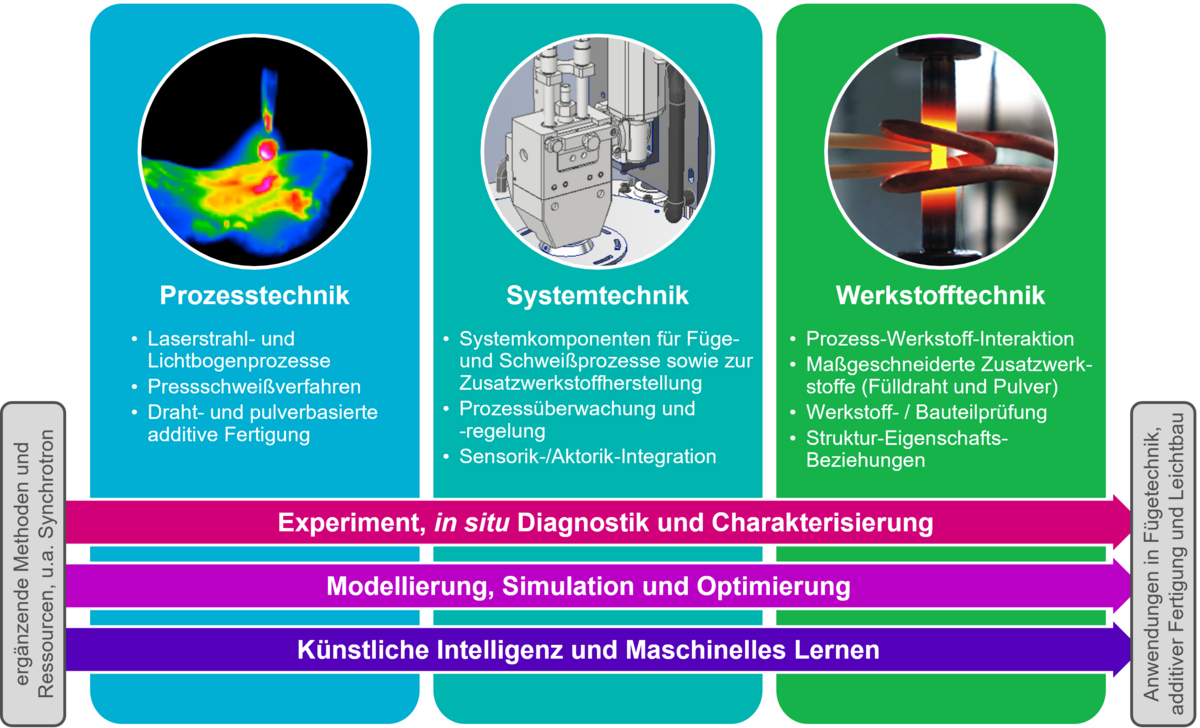
The Chair focuses on the key areas of process, systems and materials engineering, taking into account the respective application scenarios. Process engineering encompasses research into the behaviour of laser beam and arc welding processes, as well as press welding processes for joining technology and additive manufacturing. System Technology focuses on components for implementing and controlling the relevant processes, including those for the production of filler materials, process monitoring and control systems, and the integration of sensors and actuators. Materials engineering includes, amongst other things, the testing of materials and components, the subsequent determination of structure-property relationships, and the bespoke development of wire and powder-form filler materials. The integrated consideration of these key areas enables a comprehensive description of their interrelationships, resulting in significant advantages for the further development of the broad field of Joining and Welding Technology.
These key areas are linked by interdisciplinary fields: experimentation and in situ diagnostics provide an in-depth understanding of the causal relationships, which can be further explored through modelling and numerical simulation. Complex relationships are described or abstracted using appropriate methods, such as machine learning, before being fed back into System Technology in the form of control and monitoring systems. This approach, which links process, materials and system data with scientific methods, contributes significantly to the transformation of production processes.
Contact
Univ.-Prof. Dr.-Ing.
Klaus Schricker