
Reconnection of a river meander on the Dahme
When a meander is reconnected, the habitat in the river course is completely recreated, providing an opportunity for rapid colonization by river organisms such as benthic macroinvertebrates. In addition, the implementation can create structures in the river course that no longer exist in other parts of the river ecosystem.
In the case of the renaturation of the Dahme, gravel was added to raise the riverbed and prevent initial erosion and incisions, creating a heterogeneous habitat for organisms in the river, as coarser sediments are virtually absent in the nearby sections of the Dahme. The positive ecological impact of the renaturation is expected to exceed the stated objectives, and we are in the process of evaluating the effects of the renaturation of the Dahme in the riverbed in comparison to a) a meander that was never straightened but underwent some bank reinforcement decades ago, and b) the reference conditions established for the Dahme river type.
The Dahme is lowland, sandy-bottomed stream (Type 14/15 of the German River typology), with mostly sandy sediments and small areas of larger and finer inorganic sediments. The reaches studied show a dominance of sandy to gravel dominated bed with submerse macrophytes and wooden structures present. The existing (i.e. never straightened) meander reach is located downstream, close to Freidorf (Fig. X below) and is framed by oak trees, that cover and shade the stream completely, in the riparian area and surrounded by extensively farmed grassland beyond. The reconnected meander lies downstream of the Staakmühle in the municipality of Briesen (Halbe), about 500 m upstream of the existing meander. This reach is a reconnected meander with its restoration based on an old meander that was disconnected during the channelization of the river but dug up and reconnected in 2022 as part of the project “LIFE Feuchtwälder“, which is part of the Natura 2000 management plan for Brandenburg (MUGV, 2014). The ‘Horstgraben’, which is an artificial drainage channel, joins the meander at its turning point. Despite the excavation and other restoration efforts, care was taken to preserve the remaining forest and the riparian area frames the reconnected meander with trees in most places while further from the stream grassland is extensively managed.
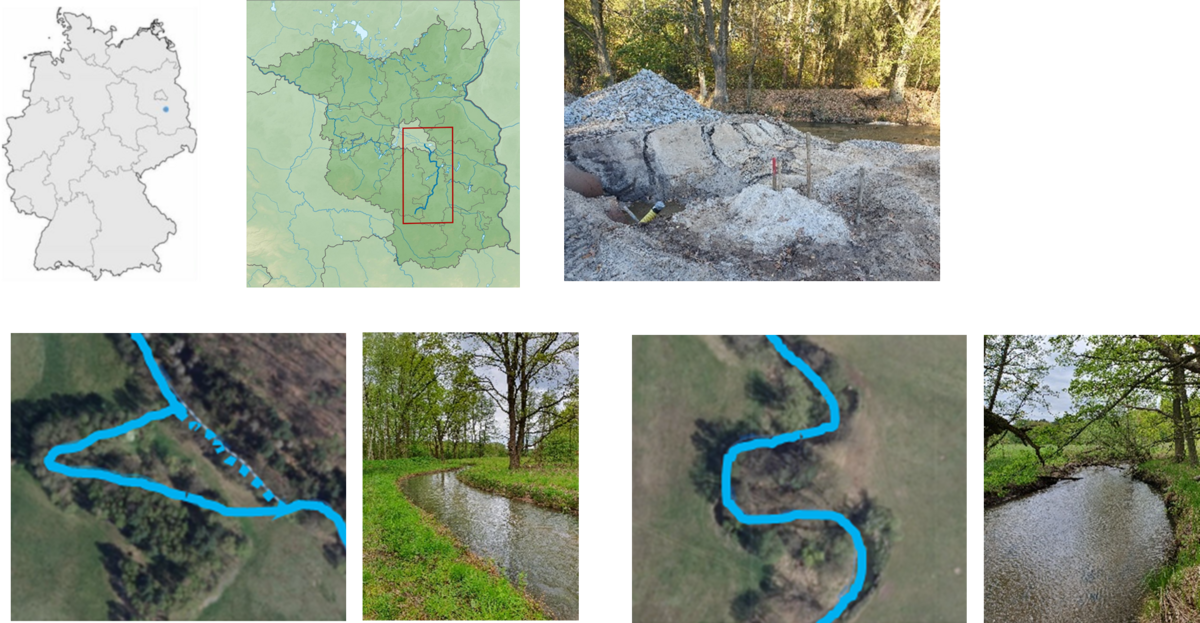
Samples were collected in monthly (April – June) from both meanders. First, habitats were assessed and their cover estimated based on the Perlodes method (at 5% increments according to the multi-habitat-sampling method) (Perlodes, 2024). In the reconnected meander six habitat types were present, namely three size classes of inorganic sediments (microlithal, akal, psammal) and three types of organic cover (xylal, fine particulate matter (FPOM), macrophytes). In the natural meander only five habitat types were present, namely one inorganic substrate (psammal) and four types of organic substrate (xylal, coarse particulate organic matter (CPOM), FPOM, submersed macrophyte). Opposed to the ‘Perlodes’ method, only 10 samples per reach were taken (instead of 20) and samples were kept individually instead of combined into a composite sample as Perlodes indicates to allow for the investigation of habitat effects. Each habitat was sampled with a kick net, with 25 cm x 25 cm framing and 0.5 mm meshing. Afterwards, the contents of the net were sieved (250 µm grid), to separate out inorganic substrates, all organic materials were collected and preserved with 95 % ethanol. Organisms were then sorted and identified to lowest possible taxonomic level (generally genus).
Evaluation of the Dahme meander reconnection near Staakmühle
Funding:
internal
Period:
ongoing
Keywords:
Dahme, river restauration, makroinvertebrates
Researchers:
J. Rüegg