

Humanoid Robot Space Making
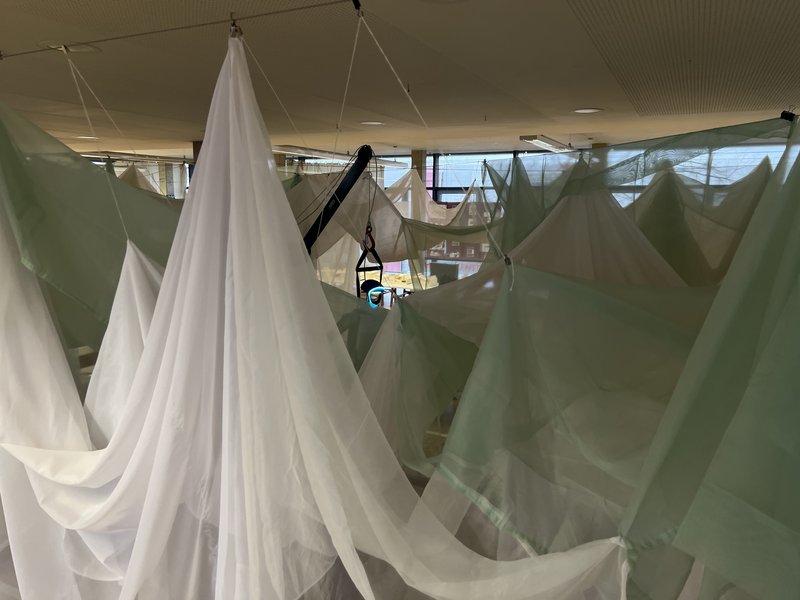
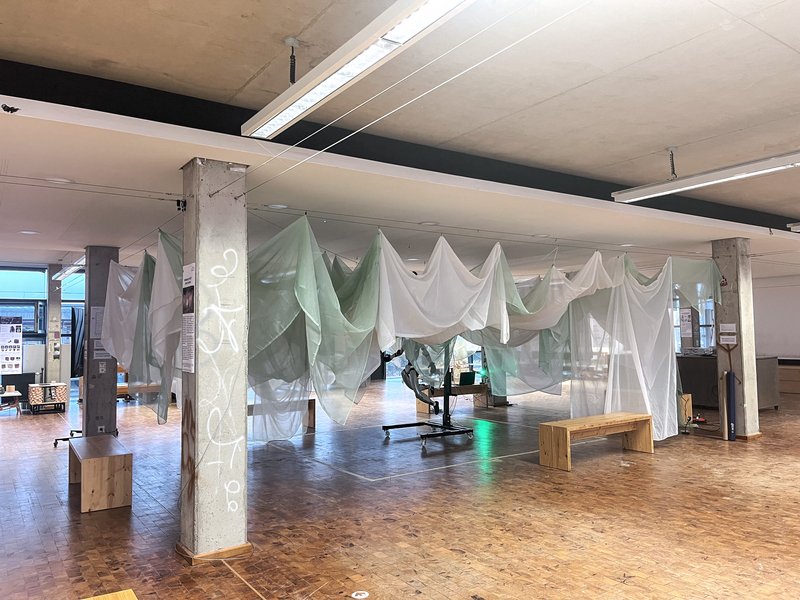
In the master’s seminar WiSe25-26 HUMANOID ROBOT SPACE MAKING, the following questions were explored: What emerges when we think architecturally about the design capabilities of a humanoid robot and create new spaces? During the semester, the humanoid robot Unitree G1 was not examined as a machine for optimizing standardized tasks, but as an active co-designer of space. The focus was on developing a spatial installation that understands architecture as a dynamic, movable state. The robotic movements were developed at a low-level using Python code, first simulated in virtual space and then transferred directly to the real robot. During the design process, the students tested various spatial concepts and prototypes, including sliding and rotating walls, ultimately arriving at the final concept using textiles. The physical limitations of the robot led to the choice of lightweight materials that can be moved with minimal force. The students developed robotic movement logics, adapted code and joint movements, and investigated how the humanoid robot itself can become an agent of spatial production—not as a tool, but as part of a moving, performative architecture. The result was a spatial scenario that continuously changes through the movements of the robot.
Supervisor: Marine Lemarié
Students: Geraldine Vella, Leander Lange, Maria Parkhomchuk, Mohamad Ayneyeh, Mustafa Bannoud, Ruoyu Li, Theo Schoenau, Wenxin Yu, Yaoxin Zhang, Zhenwei Ding