Women's Place Bilillee Machbuba

In the summer semester of 2025, students on the BTU4Future module collaborated with the artist and critical curator Patricia Vester and FrauenOrte Brandenburg to create the Women’s Place for Bililee Ajiamé Machbuba at the BTU.

The aim was to create a space for reflection on different perspectives on colonial history and, in particular, to highlight marginalised perspectives and decolonise cultures of remembrance. 

Location of the memorial plaque to Bilillee Machbuba:
Konrad-Wachsmann-Allee 4–6,
03046 Cottbus

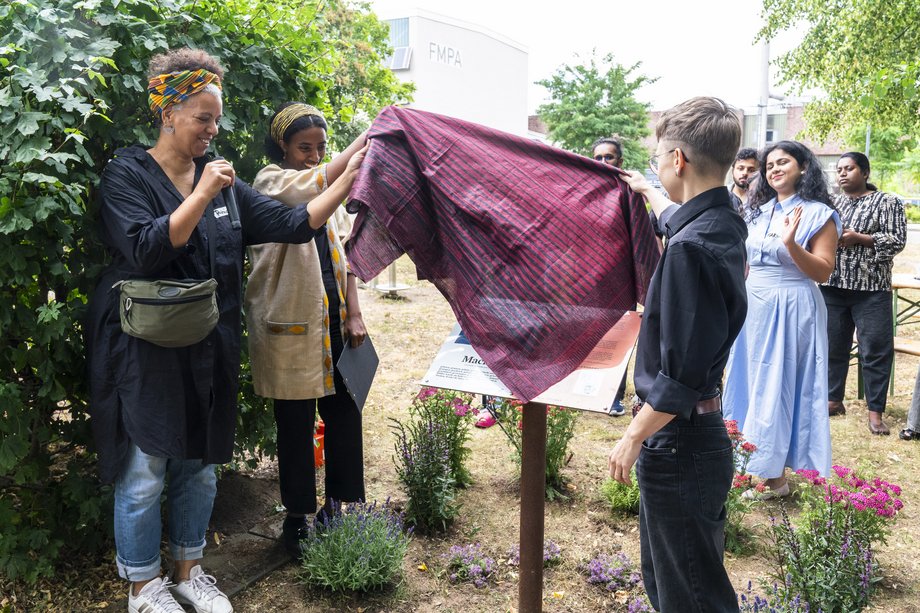
On 9 July 2025, the public opening ceremony for the Bilillee Machbuba Women’s Memorial took place at the BTU. The event was a great success, with many students, staff and members of the Cottbus public joining the open discussion on critical remembrance culture at the BTU and in Cottbus. The traditional Ethiopian coffee ceremonyprovided a wonderful backdrop to the event, with its delightful aromas and delicious coffee and popcorn. On the same day, there was also a hands-on construction day, during which the BTU4Future students further developed the women’s memorial by planting plants and building a tree bench. 

Media coverage of the event:

https://www.tagesschau.de/inland/regional/brandenburg/rbb-gedenktafel-in-cottbus-erinnert-kuenftig-an-kindersklavin-von-fuerst-pueckler-100.html

https://www.rbb24.de/panorama/beitrag/2025/07/bilillee-machbuba-fuerst-pueckler-gedenktafel-cottbus-frauenorte.html

https://www.saechsische.de/lokales/goerlitz-lk/weisswasser/brandenburg-wuerdigt-machbuba-gedenktafel-erinnert-an-die-geschichte-von-puecklers-begleiterin-YFUCMWNYZNBUPJFVYQQVDHQSGU.html

Highlights from the day

The memorial plaque for Bilillee Machbuba has stood on Konrad-Wachsmann-Allee since last December. Students on the BTU4Future module have spent the last few months working with artist Patricia Vester to further develop the women’s memorial. A space has now been created around the Women’s Place for Bilillee Ajiamé Machbuba at BTU to reflect on different perspectives on (colonial) history and, in particular, to highlight marginalised perspectives and decolonise cultures of remembrance.

Programme

12:00–16:00
Hands-on construction day for students at the Frauenort
open to anyone interested in helping out

17:00–19:00
Official opening ceremony of the 50th women’s site

17:00 Welcome

  • Prof. Dr. p.h. habil. Gesine Grande, President of BTU Cottbus-Senftenberg
  • Patricia Vester, intervention designer and process facilitator on colonial contexts, lecturer as part of "BTU4Future"
  • Elio Gäbelein, Women’s Political Council and FrauenOrte Land Brandenburg


17:30 Unveiling of the plaque and presentation of the student room design

17:45 Open discussion: Critical remembrance culture at BTU and in Cottbus

  • Dr Gabriela Willbold, initiator of Black Culture of Remembrance on Bilillee
  • Dr Stefan Körner, Board of the Fürst-Pückler-Museum Foundation
  • Dr Adeline Abimnwi Awemo, Chairwoman of the German-African Association Cottbus, member of the CDU Cottbus
  • Aline Erdmann, Equal Opportunities Commissioner for the City of Cottbus
  • Prof. Melanie Jaeger-Erben, Head of "BTU4Future" and Head of the Department of Sociology of Technology and the Environment
  • Mohamed Elhag, administrator for the Bachelor’s degree programme “Environmental and Resource Management”


18:30 Closing with a traditional Ethiopian coffee ceremony

Location: Konrad-Wachsmann-Allee 4-2, 03046 Cottbus, https://maps.app.goo.gl/SPATuBNQvZXoDpvf7

Who was Bilillee Machbuba? 

An audio walk created in collaboration with FrauenOrten Brandenburg.

Bilillee Ajiamé Machbuba – A Short Life, A Long Memory

Bilillee Ajiamé Machbuba was born around 1825 in what is now western Ethiopia, likely in the Guumma region of the Oromo territories. She was abducted during one of the many regional slave raids that ravaged East Africa in the 19th century. From there, she was trafficked via Gondar to Khartoum, a central hub in the north-eastern African slave trade (Wikipedia, 2024; Wien Museum Magazin, 2023).

Who was Bilillee? Audio about Bilillee Machbuba (produced by the students):

In 1837, whilst travelling in Egypt and Sudan, the German aristocrat Prince Hermann von Pückler-Muskau encountered and purchased the teenage Bilillee at the slave market in Khartoum. From that point on, she was known as Machbuba—a name meaning ‘beloved’ in Arabic, though it was likely imposed upon her during her captivity. Pückler brought her to Europe, where she was presented in Vienna and Muskau as an exotic curiosity. This was in keeping with the Orientalist fascination and racialised aesthetics of the time, which viewed non-European women, particularly Black women, as symbols of beauty and difference but rarely as fully human subjects (Vester, 2023).

Machbuba lived on Pückler’s estate at Schloss Muskau, in what is now eastern Germany. Despite the affluence of her surroundings, she experienced cultural alienation, isolation and declining health. She died young—on 27 October 1840, possibly from tuberculosis—when she was only around 15 to 17 years old. Pückler had her buried in the landscape park of his estate, beneath a stylised tombstone inscribed with orientalist motifs. Her grave remains to this day, situated in Bad Muskau, and stands as a physical marker of how colonial-era Europe consumed and silenced Black lives whilst aestheticising their presence (Wikipedia, 2024).

In her 2023 workbook ‘gelebt – Das kurze Leben der Bilillee Ajiamé Machbuba’, Patricia Vester reclaims Machbuba’s story from the margins of European history. She presents her not simply as an exoticised object of 19th-century fantasy, but as a symbol of historical injustice, forced displacement, and cultural erasure—and simultaneously as a person of dignity whose life speaks to resilience and memory (Vester, 2023). Vester draws on Afro-German memory practices and decolonial approaches to reinterpret Machbuba’s short life as a lens through which we can interrogate the intersections of racism, gendered oppression, and forgotten colonial violence in German history.

By remembering Machbuba, we are invited to rethink who is commemorated, how stories are told, and whose lives are honoured in our public spaces. Her story becomes part of a broader project of decolonising memory culture, not just by acknowledging suffering, but by actively restoring agency and visibility to those whose histories were silenced.

References

BTU4Future is an interdisciplinary and participatory course at BTU Cottbus that brought together students from diverse backgrounds to explore climate protection through creative and critical approaches.

In the summer semester of 2025, the course focused on cultural sustainability and the critical reflection of memory cultures, with a special emphasis on colonial history and marginalised perspectives. As part of the project, students collaborated with FrauenOrte Brandenburg to design a commemorative space for Bilillee Ajiamé Machbuba—a historical figure whose story speaks to colonial violence and forgotten resistance.

The course included a mix of online and in-person sessions, excursions in Cottbus and Berlin, and hands-on group work. It was led by guest lecturer and artist Patricia Vester, who introduced creative and decolonial methods of learning and remembering.

Through this process, students not only deepened their understanding of justice, but also actively shaped the university as a space of transformation and collective memory.


Reflections from BTU4Future Students

Working on the Machuba monument opened a quiet door in my heart where forgotten voices could finally speak ❤️ (Yasmine)

Building the Machbuba memorial was like bringing her story back to life. It showed me that sharing forgotten stories helps create a world where everyone’s voice counts and we all feel connected. (Nejla)

 I feel very fortunate to have been able to help rewrite this history. (Abnet)

Construction Day

On 9 July, the hands-on construction day took place, during which the BTU4Future students further developed the women’s memorial by planting plants and building a tree bench. 

During the semester, the students worked on various ideas and sketches for the memorial site. Only a few of these were ultimately realised. However, all the students produced excellent design ideas for the memorial site:

Furthermore, some students worked on study projects by addressing the following questions: How is Black history represented in Cottbus? Reflect on the existing commemoration of a historically marginalised person (e.g. from your home country) who has a connection to your life in Cottbus: How is this person remembered? Who created the memorial and from what perspective? When was the memorial created? How might it need to be rewritten or redesigned? Here are some of the final reports from the study projects:

Here is a collection of images showcasing all the great ideas – perhaps some of them might be adapted in the future:


Literature on the topics covered in this module

(we have printed copies available in our office in LG10 – please contact us if you would like to borrow one)


Museums associated with Bilillee Machbuba

Further Contacts