
Restoration of aquatic ecosystems
Scientific evaluation as a key elementAnthropogenic impacts on river ecosystems and the need for restoration measures
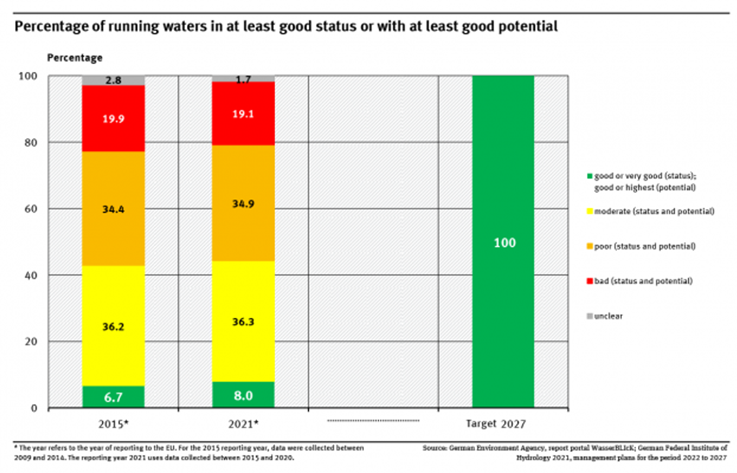
One of the main tasks of the European Union's Water Framework Directive is the assessment of aquatic ecosystems and the evaluation of their ecological status. If the status is below "very good" and "good", restoration measures must be taken to improve the health of the ecosystem. Unfortunately, in the last assessment of the ecological status of rivers in Germany in 2021, only 8% met the targets for very good or good status. In fact, more than half of the watercourses assessed were classified as poor or even very poor. Extensive measures are therefore required to maintain river ecosystems and restore their functions so that they become healthy ecosystems.
The main causes of anthropogenic impacts on aquatic ecosystems include canalisation and drainage of floodplains, excessive nutrient inputs, water abstraction and dam construction. In the case of rivers, phosphorus inputs have been combated very well and water abstraction has also been reduced. As far as dam construction is concerned, renaturalisation measures are often difficult because dams are used for the supply of resources (e.g. drinking water) or for hydropower generation, two ecosystem services that are important for humans. Similarly, many of the former floodplains are now farmland, and many drainage systems and river courses have been preserved. However, there are renaturalisation projects to return floodplain areas to the river and increase the possibility of flooding in order to preserve floodplain forests and their organism communities. One such project was carried out in the Dahme near Staakmühle (municipality of Briesen, Brandenburg, Germany), where the erosion of the river bed caused by canalisation was counteracted by filling in gravel and a formerly cut off and dried up meander was excavated and reconnected to extend the flow length by about 130 m, thus reducing the gradient and erosion of the river. The meander was then allowed to erode its banks in the hope that the nearby woodlands would be flooded.
(https://www.feuchtwaelder.de/projekttagebuch/auenwaelder-brauchen-wasser.html)
In order to evaluate restoration projects, a clear statement of the expected restoration results is needed. Unfortunately, the objectives of ecosystem restoration are often not clearly defined and projects are rarely evaluated beyond the implementation of the restoration measure (mainly due to financial constraints), making it difficult to evaluate restoration success. In other cases, restoration objectives are defined, such as in the Dahme project for riparian forests, but additional impacts are not considered or monitored.