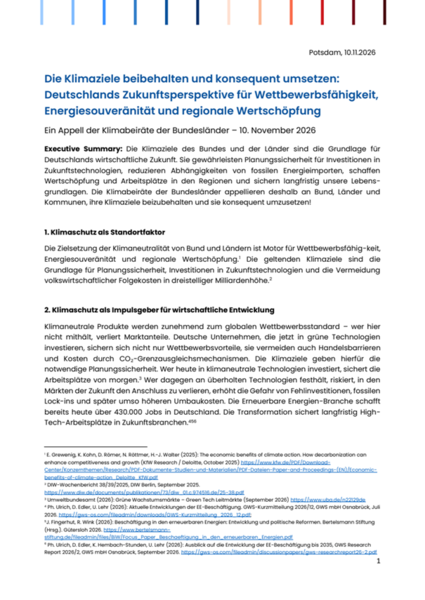
State climate advisory councils urge: Germany needs a reliable and consistent climate policy
[Berlin, Bremen, Erfurt, Hamburg, Magdeburg, Munich, Potsdam, Stuttgart, Wiesbaden], 10 November 2026. In a joint appeal, the climate advisory councils of nine federal states are sending a clear signal in favour of a consistent climate policy. On the occasion of the Energy Ministers’ Conference on 11 November in Göttingen and the start of the COP31 World Climate Conference in Antalya (9–20 November), they are calling on the federal government, the federal states and local authorities to maintain the current climate targets and implement them consistently.
The climate advisory councils emphasise that reliable climate targets are a key prerequisite for Germany’s economic future. They provide planning certainty for investments in future technologies, reduce dependence on fossil fuel imports and generate regional value creation.
“A commitment to consistent climate protection is a crucial prerequisite for successful economic development. Those who invest in climate-neutral technologies today are securing tomorrow’s competitiveness. This requires a reliable political framework, which is why a clear commitment from all those in positions of responsibility to the existing climate targets is needed,” says Jörg Knieling, Professor at HafenCity University Hamburg and deputy chairperson of the Hamburg Climate Advisory Council.
Climate-neutral products are increasingly becoming the global competitive standard. Those who invest in green technologies secure market share and, in the long term, limit the costs associated with climate-damaging production methods. Furthermore, renewable energies will have saved Germany between 18 and 25 billion euros in import costs for fossil fuels in 2023 alone. Without the accelerated expansion of renewables, grids and storage facilities, there is a risk of continued dependence on fossil fuels, with all the associated geopolitical risks. The reorientation of the energy supply towards renewable energies is, at the same time, a matter of security, regional development and industrial policy.
“Whilst global climate protection is being negotiated in Antalya, our towns and communities are demonstrating what the energy transition can achieve: wind and solar farms, as well as hydrogen projects, are creating jobs and boosting regional value creation. Citizen-led energy cooperatives give people the opportunity to get involved themselves and benefit from the returns. The revenue from these energy projects can make a real difference locally, for example by renovating nurseries, supporting sports clubs, maintaining outdoor swimming pools or enabling more affordable electricity tariffs,” says Heike Mrech, Professor at Merseburg University of Applied Sciences and chairperson of the Scientific Advisory Board on Climate Protection for the State of Saxony-Anhalt.
With their appeal, the climate advisory councils emphasise that climate neutrality is the way forward for Germany – for a competitive economy, a secure energy supply and strong regions.
The climate advisory councils advise their respective state governments on relevant climate policy issues. The full appeal, ‘Maintaining and consistently implementing climate targets: Germany’s future prospects for competitiveness, energy sovereignty and regional value creation’, can be foundhere.
Contact
Management regionaler Energieversorgungsstrukturen
T +49 (0) 355 69-4409
bernd.hirschl(at)b-tu.de